The Nuts and Bolts of Non-Contiguous Clustering

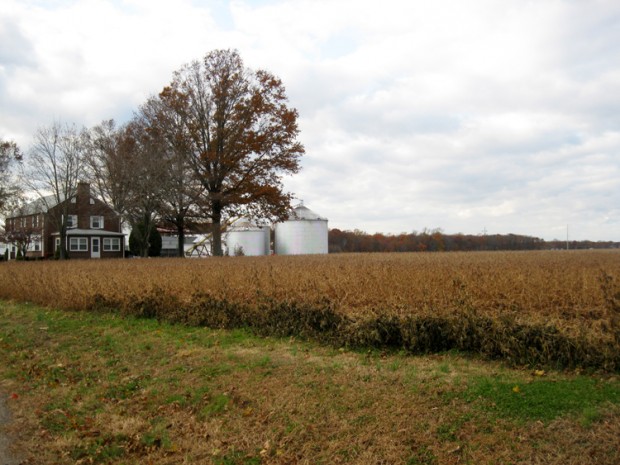
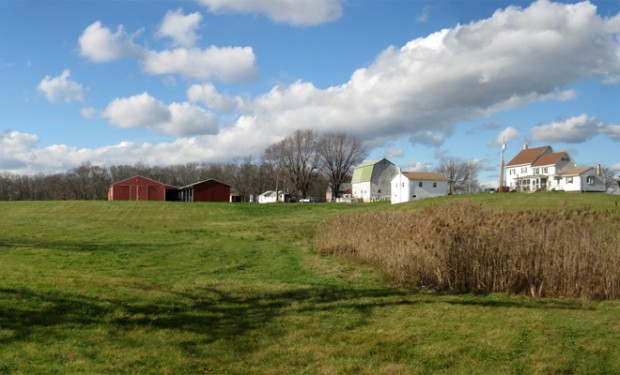
Farmland in N. Hanover. Photo: Nicole Heater
DATE: Wednesday, Nov. 7, 2012
TIME: 12:30 – 1:30 PM
FEE: $29.95. Through the generosity of the Bunbury Company, the Community Foundation of New Jersey and the William Penn Foundation, we are pleased to be able to waive the registration fee for this webinar.
Attendees are eligible for one AICP Certification Maintenance (CM) credit.
Based on New Jersey Future’s May 2012 report, this one-hour webinar features New Jersey practitioners who are successfully applying an innovative and affordable planning tool – non-contiguous cluster development. When municipalities authorize non-contiguous clustering, developers and landowners work together to preserve land and build strong neighborhoods at a lower cost to taxpayers; instead of spreading development evenly across sites, they may build it at a higher density on one of the sites and preserve the rest.
Speakers will provide practical advice on all stages of the process for planners, land use attorneys, planning board members, local officials and interested citizens. They will start at the beginning – the community conversations and decision-making involved in adopting a non-contiguous cluster ordinance – then explain how to tailor a non-contiguous cluster ordinance to meet community goals, and finally highlight implementation through two diverse development projects. Attendees will have an opportunity to ask questions.
Agenda and Speakers:
-
Frank Banisch, president, Banisch & Associates
Francis J. Banisch III, PP/AICP, president of BAI, has been a community planning consultant serving New Jersey municipalities since 1972 in the preparation of conservation-oriented master plans, development ordinances, and planning analyses.
Mr. Banisch brings to the planning profession an architecture and design orientation, and has focused his career in the areas of urban design and environmentally sound land management. He has professional experience in the preparation of resource management tools to protect the State’s diverse natural and cultural resources, and the shaping of development proposals to promote land-use compatibility and to enhance the quality of life.
Mr. Banisch is currently a member of the Board of Counselors of the New Jersey Planning Officials (NJPO) and serves on the Municipal Land Use Law Technical Review Committee. He is the author of “The Conservation Plan Element” chapter of the New Jersey Municipal Master Plan Manual prepared for NJPO. He serves as an adjunct professor at Rutgers University.
Previously, Mr. Banisch served in an advisory capacity as a representative of the Municipal Council in the development of the Pinelands Comprehensive Management Plan, and was a member of the Pinelands Cultural Resource Management Plan Advisory Committee. He was also a member of the Rural Policy Technical Advisory Committee to the Office of State Planning in the review of the Draft State Development and Redevelopment Plan.
Mr. Banisch has served as vice president of the New Jersey chapter of the American Planning Association, a trustee of the Upper Raritan Watershed Association and president of the Whitesbog Preservation Trust.
Mr. Banisch holds a bachelor of arts degree in architecture and urban planning from Princeton University. He is a licensed professional planner in New Jersey and a member of the American Institute of Certified Planners.
-
James M. Dowd, member, Delaware Township Planning Board
Jim Dowd has been a resident of Delaware Township since 1999 and a member of the township planning board since 2008. He played an integral role in writing the township’s alternate power ordinances, its non-contiguous cluster ordinance and its hamlet ordinance. He is also currently the chairman of the township’s Open Space Advisory Committee, a role he has had since 2009. Prior to moving to Delaware Township he was an advisory member of the Tewksbury Township Planning Board.
Mr. Dowd is a graduate of Rutgers University with a B.S. in management, and has spent his career as a systems and software engineer.
-
John Riggs, director of planning and environmental protection, Monroe Township
John Riggs is the director of planning and environmental protection and chairman of the Environmental Commission in Monroe Township. Considered one of the most knowledgeable people about the township, he advises the planning and zoning boards and watches for potential environmental problems as well as opportunities. Protecting the natural resources and open space for Monroe Township residents has been key in his work.
Members of the Environmental Commission inform elected officials and the public, serve on committees, research issues, develop educational programs and advocate for sound environmental policies. They are active on many levels, including open-space preservation, wetlands and water resource protection, green infrastructure, clean-ups, use of public transportation, education programs for children and information on new technologies and programs for adults.
Prior to his current role Mr. Riggs spent 17 years as an at-large member of the Monroe Township Council. He began his public service in Monroe as a PTA executive board member, and later served for eight years as chairman of the township’s Zoning Board of Adjustment. He is also a past member of Monroe’s Affordable Housing Board, and a representative on the Planning Board. Mr. Riggs is also the municipal housing liaison for the township.
-
Chris Sturm, Senior Director of State Policy, New Jersey Future (moderator)
Chris Sturm is responsible for policy development and advocacy across a host of policy issues including state and regional planning, environmental protection, transportation, and economic development incentives. She co-chaired the Transfer of Development Rights Statewide Policy Task Force and spearheaded New Jersey Future’s Smart Housing initiative. Her career experience includes serving as the assistant director of the Capital City Redevelopment Corporation, as well as working for the MSM Regional Council (now PlanSmart NJ), the Eagleton Institute, and the Office of State Planning. She holds a master’s degree in Public Affairs from the Woodrow Wilson School at Princeton University, where she concentrated in Urban and Regional Planning.