




Vince Calio of NJBIZ wrote an opinion piece recently highlighting New Jersey’s “perpetual traffic jams” as a serious deterrent to Amazon in its search for a location for its second headquarters. He is correct: New Jersey’s best-in-class traffic congestion is a serious deterrent to many employers interested in attracting and retaining a talented workforce. Time in traffic is bad for health, bad for family life and bad for civic engagement. And Amazon appears to know that: One of its core location requirements is access to a robust transit network.
But, to alleviate the state’s gridlock, Mr. Calio proposes investment only in road expansion: “Billions of more dollars will be needed to provide New Jersey with what it truly needs to fix its roads and remain competitive: new express lanes, new highways, new bridges and various road-widening projects.”
Transportation experts around the country know that this approach to alleviating congestion is, as Strong Towns’ Charles Marohn among others puts it, “like trying to solve obesity by buying bigger pants.” It’s the theory of induced demand — “if you build it, they will come.” And with new roads, the traffic always comes.
We need to get at the underlying problem that is causing this congestion: Too many people are commuting by car, by themselves. There is a complex network of reasons for this. Over the last 25 years we have dispersed jobs to far-flung corners of the state, where the grass is green but there is no public transportation available. Housing in these areas is comparatively far apart, which means long commutes. Many communities where housing is expensive have tended to resist building more affordable homes — for the people who wait tables at the local restaurant, or who sweep floors in the local school — so those workers have to commute from where they can afford to live, which is often far away. And many communities’ zoning codes, first developed in the 1970s and 1980s, call for strict separation of land uses and housing types, making it impossible by ordinance for people to live near their work in the kind of residence they want.
So while we do indeed need to fix and modernize the road network we already have, we don’t need to add to it. Instead, we think the incoming governor should take steps to alleviate the underlying problem. Here are some places to start:
- Invest in the state’s public transportation network. Let’s get the trains running on time, the service levels back up, and the fare interoperability challenge solved so people can pay once and transfer seamlessly from park-and-ride to rail, light rail, bus, PATH and bikeshare networks. Los Angeles is already testing this.
- Bring jobs closer to transportation. This is already a priority, and should continue to be. The state’s Economic Development Authority puts a premium on proximity to transit when it calculates incentives, and while some may object to the idea of paying a company to move eight miles, Panasonic now boasts that more than half its Newark workforce commutes to work by transit, as opposed to almost none while the company was located in Secaucus. Consider the number of commuting cars that are no longer on the roads as a result, and multiply that by the same percentage of employees at every company that moves out of a car-dependent location, and you begin to see a real benefit of locating jobs near transit. In addition, jobs near transit are accessible to lower-income workers who can’t afford the expense of a car, giving them greater opportunity to contribute to the state’s economy.
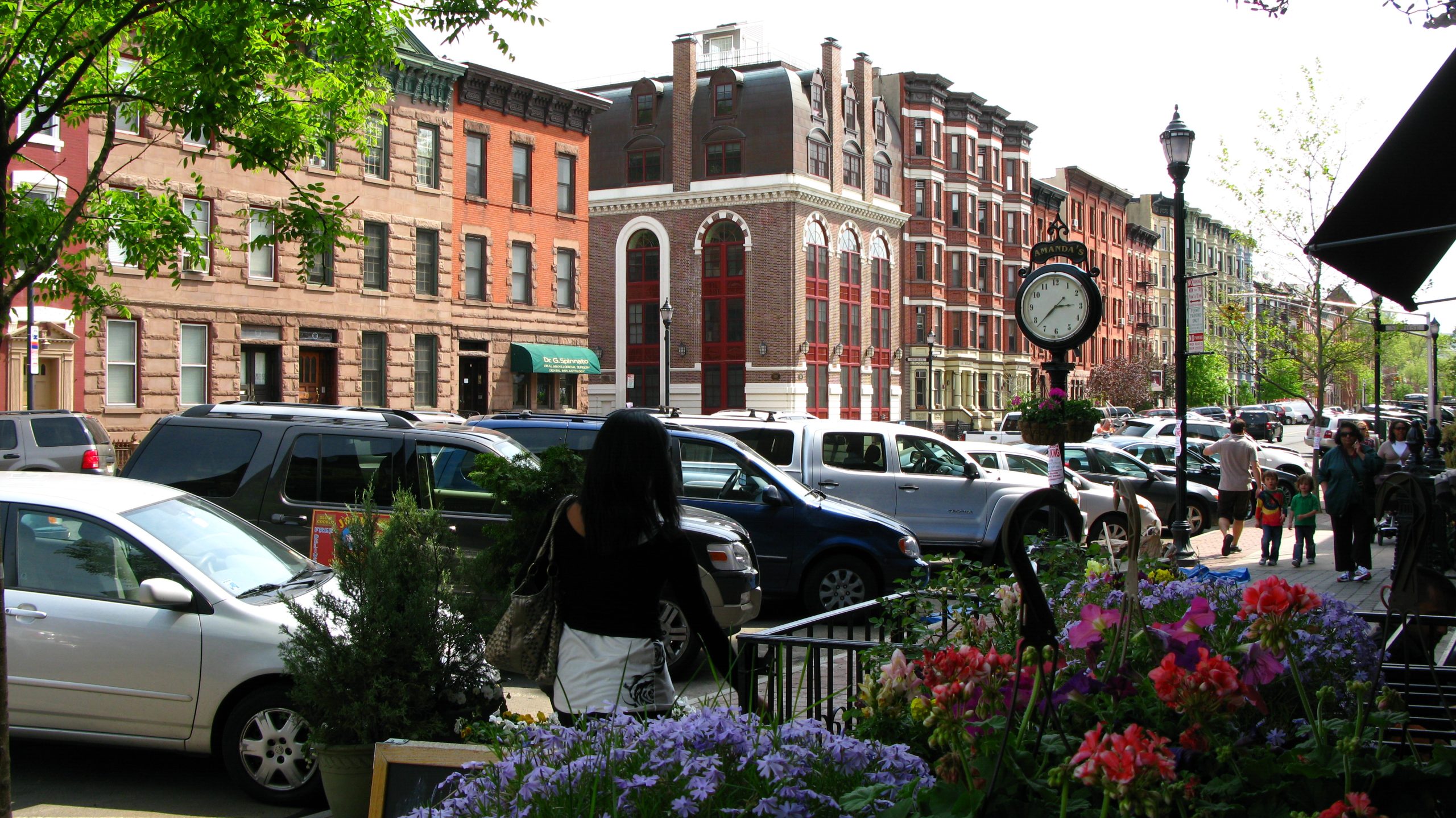
- Bring housing closer to transit. People who live near public transportation, and especially in areas where parking access is restricted, report a lower rate of car ownership and use than people who live where there is no transit service available. But many communities are proscribed by their zoning ordinances from developing housing and lowering parking requirements around their transit assets, if those areas are zoned only for commercial or retail. The incoming governor could provide grants and technical assistance to help towns served by transit to modernize their ordinances in ways that foster higher-density, mixed use transit-oriented development and appropriate parking requirements. (Some towns are already starting to do this; Metuchen offers a good example.) And, as noted above, lower-income workers who can live near transit will have access to a greater variety of employment opportunities than those whose housing location requires them to commute by car.
The incoming governor is going to face some stiff challenges, particularly fiscal challenges, during the early days of the new administration. There are smart investments to be made in infrastructure upgrades that will grow the state’s economy and help to mitigate those challenges, but widening highways is probably not one of them.
See all the recommendations in New Jersey Future’s gubernatorial blueprint.
Elaine Clisham is the director of communications for New Jersey Future, a nonpartisan not-for-profit organization that promotes policies for sustainable growth and development in New Jersey.
Related Op-Ed Articles
07/03/2025
11/20/2024

10/11/2023

08/09/2023
04/14/2023
12/01/2020
10/25/2020

08/10/2020

06/25/2020
05/19/2020

05/17/2019

09/17/2018
09/06/2018

06/19/2018
05/17/2018
04/10/2018
03/14/2018
01/08/2018
12/17/2017

11/30/2017
10/15/2017
09/17/2017
08/23/2017
06/11/2017

10/28/2014

03/19/2014

09/04/2013
11/30/2012
02/09/2012