

 Browse All News
Many Older Residents in New Jersey Live in Aging-Unfriendly Places




Bergen, Passaic communities more accommodating, but need more appropriate housing
The majority of municipalities in Bergen and Passaic counties are better prepared than most of the rest of the state to accommodate an older and less mobile population. This observation is among the findings of a research report recently released by New Jersey Future, Creating Places to Age in New Jersey, that evaluates municipalities’ land-use patterns based on how well designed they are to accommodate the changing mobility needs of an aging population. In evaluating municipalities, the report considers four key development characteristics – density of destinations, presence of a mixed-use downtown, existence of a well-connected street network, and access to public transportation – that enable older residents to accomplish their daily activities without having to drive long distances on busy regional roads.
Nearly half of all municipalities in Bergen and Passaic counties – 38 out of 86 – score high on all four measures of aging-friendliness. Together, these municipalities host 61 percent of all residents aged 55 or older in the two counties; this is nearly double the corresponding 31 percent of older residents statewide who live in high-scoring municipalities. Two-thirds of Bergen and Passaic counties’ 55-and-over population lives in a municipality that has some sort of downtown, based on the report’s methodology. Fully 80 percent of them live in municipalities having at least six local bus stops per square mile.
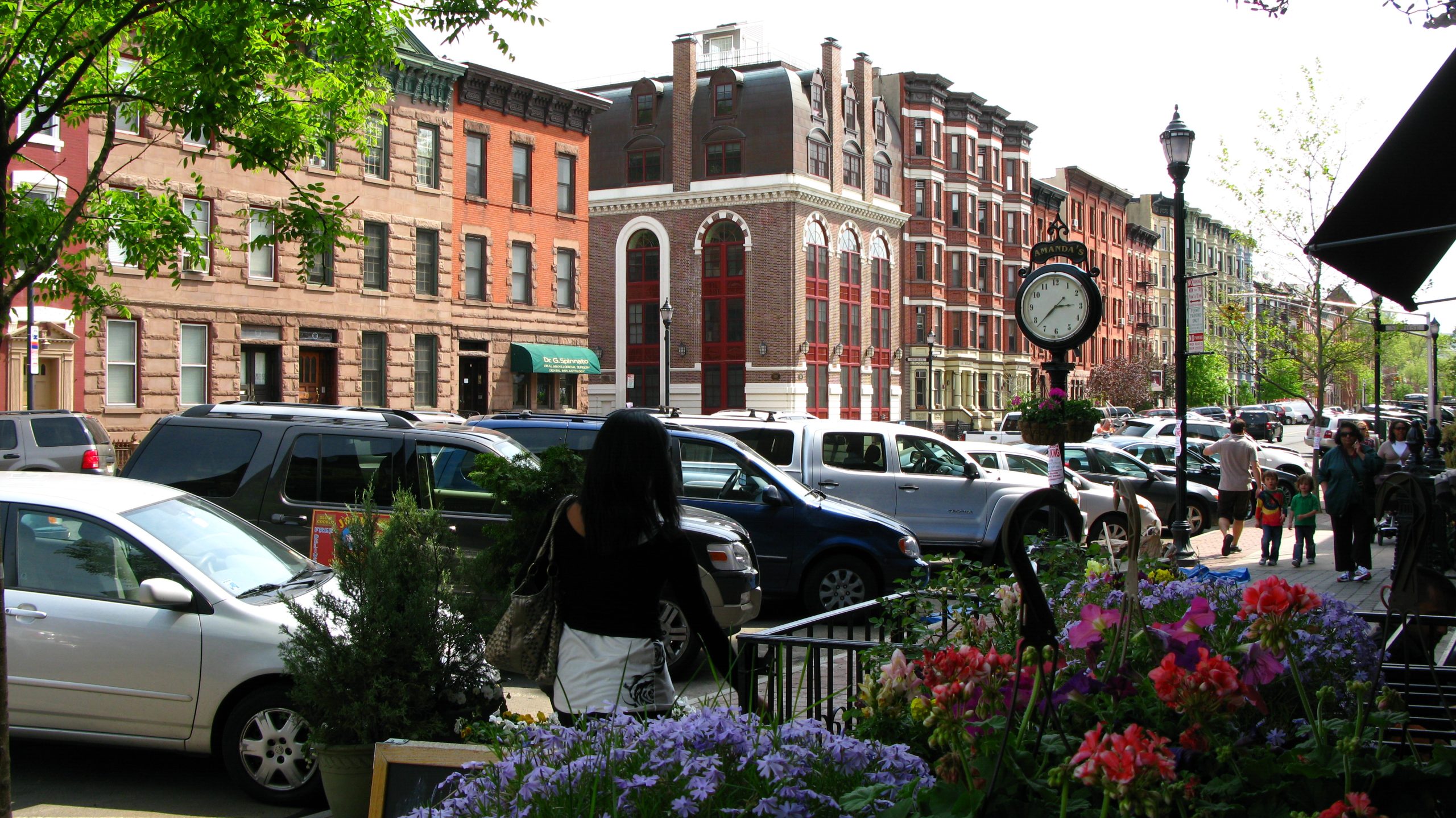
Why do Bergen and Passaic score so much better than the rest of the state? Most likely, it has to do with the era in which the counties experienced most of their growth. Except for the still-developing far northern reaches, most of the rest of the two counties’ municipalities have inherited their relatively pedestrian-friendly, less car-dependent development patterns from an earlier era, before the rise of Interstate highways and cul-de-sac subdivisions. (However, while Bergen and Passaic counties generally perform much better than most of the rest of the state, they are not immune to the problem of mobility-challenged older residents potentially being isolated in low-density, use-segregated suburbs. About 10,000 people over age 55 live in the five northern municipalities that rate poorly on all four development characteristics – Alpine, Franklin Lakes, Old Tappan, and Saddle River in Bergen County and Ringwood in Passaic County.)
Even in the places that are best equipped, from a development standpoint, to enable residents to age in place, not all the news is good. The report finds that half the places in the two counties that have the most aging-friendly characteristics are undersupplied with housing types that are appropriate for older residents. For example, Englewood Cliffs, Fair Lawn, and Totowa all have good development patterns but also have housing stocks that are more than 75 percent (compared to 54 percent statewide) composed of single-family detached units, meaning they have a shortage of the multi-family housing that is likely to appeal to older residents who no longer want to worry about maintenance and yard work, or even stairs. And in the majority of the best-scoring municipalities, the growth in large housing units (having nine or more rooms) outstripped the growth in more modest homes with between four and six rooms. The municipalities whose development patterns are best suited to older residents are, unfortunately, not necessarily prioritizing production of housing that is better suited to these residents’ needs.
Much of the rest of the state is even less fortunate. The last 50 years’ worth of low-density suburban development have set the stage for a slow-motion crisis, in which hundreds of thousands of older residents are increasingly stranded in car-dependent environments as the physical impairments that come with age gradually erode their ability to drive. The report identifies an already significant mismatch between where large numbers of older residents live and which municipalities are best prepared, from a land-use perspective, to accommodate them. Almost 300,000 New Jersey residents aged 55 or older currently live in one of the 109 New Jersey municipalities that score poorly on all four of the aging-friendliness metrics. And only a little less than a third of all older residents live in a municipality that scores well on all four measures, meaning that the majority of the state’s older population lives in an area where at least some aspects of the built environment work against the prospect of longer-term independent mobility.
This problem is going to get bigger. Across America, people are living longer, thanks in part to advances in medical technology. Older people are also remaining independent longer than they used to, rather than moving in with younger relatives or into institutional living quarters. As of 2012, more than 2.3 million New Jersey residents – 26.6 percent of the state’s population – were at least 55 years old, with more than half of that total over the age of 65. Nearly 200,000 were 85 or older. The trend is only going to get more pronounced in the future, with the aging of the huge Baby Boomer cohort.
New Jersey is ill-prepared for the coming growth in its older population. But perhaps it is not too late to adapt, to begin trying to provide what older adults are likely to be seeking as they age. Making New Jersey’s municipalities more amenable to an aging population will involve a whole suite of strategies. In places like many of those in Bergen and Passaic counties that are already blessed with “good bones” – i.e., development patterns that already facilitate easier and more efficient trip-making– solutions should focus on diversifying the housing stock, making sure these towns are well supplied with the types of housing that people are likely to want as they age, and at prices affordable to retirees, who are typically on fixed incomes. (Bergen and Passaic are two of the more expensive counties in New Jersey, which is already one of the most expensive states in the country.) In many parts of Bergen and Passaic that lack any remaining developable land, adding new housing types will almost necessarily have to be accomplished via redevelopment of existing properties. In lower-density, car-dependent places (like Franklin Lakes or Ringwood), officials and developers should look for retrofitting opportunities, with the goal of creating new pedestrian-friendly downtowns in places that never had them.
In any case, doing nothing is not an option. The graying of the population is a statewide – indeed, nationwide – phenomenon. We need to start preparing good places for people to age.
Related Op-Ed Articles

07/03/2025
11/20/2024

10/11/2023

08/09/2023
04/14/2023
12/01/2020

10/25/2020

08/10/2020

06/25/2020
05/19/2020

05/17/2019

09/17/2018
09/06/2018

06/19/2018
05/17/2018
04/10/2018
03/14/2018

01/08/2018
12/17/2017

11/30/2017

10/30/2017
10/15/2017
09/17/2017

08/23/2017

06/11/2017

10/28/2014

09/04/2013
11/30/2012
02/09/2012