






By Chris Sturm and David Kutner
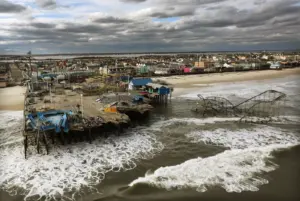
Two years after the devastation wrought by Hurricane Sandy, many of New Jersey’s coastal communities continue to struggle with recovery and rebuilding efforts. The highest community priority is to get people back into their homes, re-establish business operations and return to life as close to normal as possible. The elected officials who have led these efforts are hardworking heroes. But it’s also clear that recovery decisions made without a clear understanding of future risks can move people back into harm’s way, build infrastructure that will be damaged again, and waste taxpayer dollars. The time has come for leaders to focus on understanding risks and ensuring resiliency.
A few months after Sandy, and with the support of several private foundations, New Jersey Future initiated a program that embedded local recovery planning managers (LRPMs) in three pairs of neighboring communities – Sea Bright and Highlands, Little Egg Harbor and Tuckerton, and Commercial and Maurice River – that experienced severe hurricane damage. The LRPMs work directly with municipal staff, provide much-needed additional capacity to plan and manage recovery projects and help to secure funding for implementation.
The LRPM is preparing a detailed assessment of each municipality’s risk of, and vulnerability to, future flooding and sea-level rise. The assessment is a fine-grained, parcel-based mapping analysis that predicts depths of inundation under various future scenarios, models resulting structural damage and calculates financial exposure and potential tax revenue losses. This level of detail is essential if the community is to reach a realistic determination of how and where to allocate extremely scare personnel and financial resources most effectively.
Unfortunately, confronting the reality of future flooding risks along New Jersey’s coast is difficult, because, in short, the news is not good. New Jersey Future’s analyses in four of the communities in which it is engaged shows that as sea levels rise, large areas will be under water or damaged by floods. Many will not be viable and property tax revenues will shrink dramatically.
These analyses of vulnerability are forming the foundation for the challenging but essential community discussion of the likely impacts of sea-level rise. Sea Bright Mayor Dina Long and Highlands Borough Mayor Frank Nolan have already begun a series of community meetings to share this information with residents and engage them in a dialogue about the future. Further north, we see Hoboken Mayor Dawn Zimmer asking how her city can live “with water,” and garnering hundreds of millions of dollars in grant funds to help answer that question.
These are particularly difficult discussions for local officials in New Jersey because to date (unlike in neighboring states) few of our state policies have confronted this question. The official focus has been to rebuild and reset the clock. But as New Jersey Future’s local assessments have shown, all coastal communities need to map areas at risk, set appropriate policy – whether to fortify, accommodate or retreat – and then act accordingly.
The vulnerability analyses also make it clear that individual municipalities cannot address the projected impacts of sea-level rise effectively on their own. These are issues that demand coordinated regional and state-level response. (See sidebar for a list of next steps to move New Jersey’s coastal communities toward resilience.) On a daily basis, local officials balance political pressure to rebuild as soon as possible with the growing knowledge that merely returning a community to its pre-storm state only puts people and property back in harm’s way. Although a considerable amount of recovery work remains to be done, as the shock of the storm continues to recede we must also consider how best to equip our municipalities to confront future risk.
SIDEBAR: Next Steps in Resilience
Two years after Sandy, we are not ready for future storms. But state and municipal leaders have numerous opportunities to enhance resilience. Here’s New Jersey Future’s short list of recommended actions for the coming year:
Face the Facts. The state should adopt official projections for sea-level rise. The state and each county and municipality should map the areas likely to be flooded today and in 2050 and adopt that map as part of their land use plans (either the State Development and Redevelopment Plan or county and municipal master plans) and hazard mitigation plans in order to drive resilient investments. The Department of Community Affairs’ Post Sandy Planning Assistance Grant Program should explicitly require such mapping for coastal communities, provide adequate funding and encourage regional solutions.
Hold the Tough Conversations. Elected leaders need to share the difficult news with residents, and communities should discuss strategies to respond: fortification, accommodation or retreat. State officials should provide support by attending meetings and offering road maps for municipal coastal policies.
Raise Elevation Standards. The state today requires building standards to mandate one foot of “freeboard” above the 100-year flood level. But that won’t be enough in 2050 when sea levels could be more than two feet higher than today. The state’s freeboard standard should be increased by a minimum of two feet, to a total of three feet, for coastal areas, with a finer-grained analysis required for large public infrastructure and areas subject to wave action. The state should engage Rutgers University to refine the standards and then embed them into grant programs like the new Energy Resilience Bank and into state regulations such as for water and wastewater treatment plants.
Lead by Example. The state must revise its Hazard Mitigation Plan to explain how it will upgrade state-owned infrastructure – tunnels, roads, parks, rail storage and other operations – to be safe into the future.
Protect the Most Vulnerable. Funding for rebuilding housing, upgrading and fortifying community infrastructure, and buying out flood-prone properties should be prioritized for those with the fewest resources. Resilience efforts should not leave anyone behind.
Fight Climate Change. In the long run, all New Jersey residents must to do their share to reduce climate change. State and local governments, businesses and residents need to look at how they contribute to global warming and figure out ways to reduce that impact. The state should drive policy change based on the Global Warming Response Act, which calls for reducing greenhouse gas emissions by 80% by 2050.
In the near term, New Jersey’s ability to compete for millions of dollars of funding offered by the federal National Disaster Resilience Competition will hinge on its commitment to the kinds of resilience actions outlined above. In the long term, the economic prosperity of our state depends upon it. Sandy was only the most recent in a series of major flood and storm events in New Jersey over the past decades, and no one can argue that it was the last. It’s time for our elected leaders to work with their constituents and together face the difficult news about the future.
Related Op-Ed Articles
07/03/2025

11/20/2024

10/11/2023

08/09/2023

04/14/2023
12/01/2020
10/25/2020

08/10/2020

06/25/2020
05/19/2020

05/17/2019

09/17/2018
09/06/2018
06/19/2018
05/17/2018

04/10/2018
03/14/2018

01/08/2018
12/17/2017

11/30/2017

10/30/2017
10/15/2017
09/17/2017

08/23/2017

06/11/2017

03/19/2014

09/04/2013
11/30/2012
02/09/2012