


 Browse All News
Rethinking the Future of the Shore in an Age of Climate Change




By Thomas H. Kean and Peter Kasabach
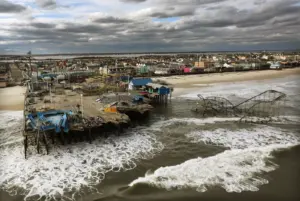
The 2017 hurricane season has already brought the U.S. three devastating storms, and the season doesn’t end for another two months. As Puerto Rico and the U.S. Virgin Islands struggle to recover from Maria, Florida from Irma, and Texas from Harvey, New Jersey approaches the fifth anniversary of its own terrible hurricane. Despite the lessons we should have learned from the $70 billion of damage wrought by Sandy, and the numerous storms that preceded it, our 130 linear miles of coastline and 239 coastal towns remain as vulnerable to another hurricane as they were in 2012.
Preoccupied with a desire to return the coast to its pre-storm state, we have done very little to prepare for another Sandy – which hit our shores with 80-mph winds and a storm surge that reached as high as nine feet – let alone a Maria, which made landfall in Puerto Rico with winds at 165 mph. Given rising sea levels and a warming climate, the chance of another Sandy or a more powerful storm hitting New Jersey is increasingly likely. New Jersey’s municipalities urgently need state-level direction and assistance to move forward with a regional approach for climate adaptation and preparedness.
Responding to current threats of climate change and sea level rise is far too big an endeavor for New Jersey’s coastal municipalities to tackle individually. Recovery agencies working with municipalities affected by Hurricane Sandy found that no municipality was equipped to respond to the damage it experienced. In Sea Bright Borough, for example, 50 percent of businesses were destroyed and half of the borough’s residents were forced from their homes. It was months before officials could contact many of the displaced families. In some coastal towns, residents are still not back in their homes today.
The rising costs of responding to severe weather events increase the likelihood that future storms will deliver an overwhelming or even fatal financial blow to some of New Jersey’s coastal municipalities. And that would be devastating for the entire state’s economy. In 2016, five counties – Atlantic, Cape May, Middlesex, Monmouth, and Ocean – accounted for $22 billion in tourism revenues, or more than half of New Jersey’s total tourism dollars. Additionally, Atlantic, Cape May, and Ocean counties host approximately one-third of New Jersey’s more than 300,000 tourism jobs, accounting for a significant share of total employment in these counties.
Financial burden to municipalities aside, planning experts agree that resiliency strategies cannot be implemented successfully on a community-by-community basis. Uncoordinated, individual responses often result in unintended adverse impacts on neighboring communities. In the same way storms are unconstrained by municipal boundaries, so too, should New Jersey’s resiliency strategy be unhindered by such boundaries. It is high time New Jersey adopt a regional approach to coastal preparedness.
To begin, New Jersey should develop a long-term coast-wide management plan as the framework for state and local infrastructure and capital budgeting, with a regional implementation and adaptation strategy. This plan is critical for laying the groundwork and providing direction for counties and towns to coordinate decisions about local infrastructure investment. States like Delaware, New York, Rhode Island, and Maine, all with vulnerable coastal areas, have adopted state- and coast-wide plans for adaptation and resiliency. These plans could serve as models for New Jersey.
Second, New Jersey should consider the establishment of a regional coastal commission to evaluate the issue of sea-level rise adaptability and develop effective strategies to protect our vulnerable coastal communities. This is not a new idea. The Kean administration first proposed a coordinating authority with the important mission of supporting our coastal communities 30 years ago. But it’s even more imperative that we consider this idea now: New Jersey residents and businesses are already grappling with recurring flooding conditions, and need to prepare for the long-term fiscal, social, and equity impacts of climate change. The greatest risk of all is that we wait too long to plan for what we know is coming.
New Jersey has long been a national leader in effective regional planning to protect vulnerable areas. Using prior successful prototypes like our own Meadowlands Commission, a regional coastal authority should explore revenue-sharing policies to help coastal municipalities make the right decisions about where and how future development and rebuilding occurs.
Last, but certainly not least, New Jersey state government should assume a leadership role in helping coastal towns reimagine their futures and discuss options for shifting development out of harm’s way. These conversations will be difficult, require extensive analysis, and take time. However, starting a dialogue about the future of New Jersey’s Shore is an integral part of any climate adaptation and mitigation planning and should begin immediately.
Thomas H. “Tom” Kean was governor of New Jersey from 1982 to 1990. Peter Kasabach is the executive director of New Jersey Future, a nonpartisan not-for-profit organization that promotes policies for sustainable growth and development in New Jersey. On Oct. 17, experts and thought leaders from around the state will continue this important dialogue at “The Big Conversation: The Shore of the Future,” at the Trenton War Memorial.
Related Op-Ed Articles

07/03/2025

11/20/2024

10/11/2023

08/09/2023

04/14/2023
12/01/2020
10/25/2020

08/10/2020

06/25/2020
05/19/2020

05/17/2019

09/17/2018
09/06/2018
06/19/2018
05/17/2018

04/10/2018
03/14/2018

01/08/2018
12/17/2017

11/30/2017

10/30/2017
09/17/2017

08/23/2017

06/11/2017

10/28/2014

03/19/2014

09/04/2013
11/30/2012
02/09/2012