






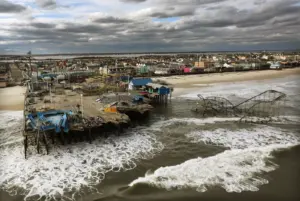
Losing a home and all its contents during a natural disaster is one of the most traumatic events a person can experience. Since 2013, I have worked closely with elected officials and residents from coastal towns in New Jersey who experienced this scale of loss during superstorm Sandy. And, like many, I have watched the recent tragedies of Hurricanes Harvey and Irma unfold on national television, their survivors returning home only to learn that they lost everything.
In the aftermath of extreme weather events, efforts are typically focused on returning to “normal” as quickly as possible—removing debris, getting residents back in homes, and businesses back in operation. Attention then turns to rebuilding—to getting things back to the way they were. Although temporarily reassuring, a return-to-“normalcy” approach does little to combat the real problem contributing to these losses in recent years—the problem of sea level rise and its increasing impact on our coastal communities. Recent storms have been trying to tell us something, but we have not been listening. We can no longer depend on a return-to-normalcy approach when there is an entirely new normal.
Almost every year for the past two decades, New Jersey has experienced a presidential-declared disaster. In addition, many of our towns now experience chronic flooding during regular high tides. When I first met Mayor Dina Long of Sea Bright Borough, she was wearing hip-high waders. She told me this was typical, that her town experiences monthly flooding and waders now are standard-issue borough attire. Projections indicate that New Jersey’s tidal flooding will only grow worse, while we face the inevitability of more storms as severe as Sandy, Harvey, and Irma, due to a warming atmosphere that retains more moisture. As sea levels rise, the surges from these storms become more devastating, and the economic impact of each storm increases.
Despite Sandy’s destructiveness and regular tidal flooding, many local New Jersey officials remain reluctant to discuss climate change and sea level rise with affected residents because, in one councilman’s words, such discussions “will scare the hell out of them.”
Frankly, I can’t imagine anything scarier than facing a Sandy or a Harvey or an Irma on a more consistent basis and remaining as unprepared as we are today, five years after Sandy.
While New Jersey has done very little to prepare for rising sea levels, other states, including Massachusetts, Rhode Island, New York, Maryland, Delaware, Virginia, and North Carolina, have taken aggressive steps toward transforming their coastal towns into communities that can continue to thrive in the face of sea level rise and a changing climate. It is time for New Jersey to follow suit and incorporate climate risk into its own planning and decision-making. We cannot afford to do nothing for another half-decade.
To start, New Jersey needs to establish uniform, forward-looking sea level rise standards and guidelines for mitigation planning. The New Jersey Climate Adaptation Alliance has published sea level rise projections that should be incorporated into all state infrastructure and land-use planning and decision-making. Our state, county, and local agencies must use the best available science to ensure that no critical facility is located in an area subject to current and future flood risk.
We must require and provide financial assistance and planning tools to enable every coastal municipality to figure out how much is at risk of being lost or damaged due to sea-level rise. These assessments need to be performed immediately. While sea levels are rising and damage from coastal storms is becoming more severe, we still have some time to plan and enact rational adaptation and mitigation strategies. Land use changes that ensure that people and property are not in harm’s way will take time and political courage.
New Jersey has a unique opportunity with the November gubernatorial election to make real progress on improving our capacity to respond to major weather events. Both candidates have recognized the threat of rising sea levels. We need to hold them accountable in addressing this serious and accelerating threat. The next governor should work swiftly to establish a position of chief resiliency officer, as many other cities and states across the country have already done. This cabinet-level ombudsperson could streamline and coordinate planning and response across state agencies through a comprehensive resiliency strategy and implementation plan for the state—a plan that would incorporate New Jersey’s unique coastal and riverine risks and establish long-term climate adaptation goals.
October 29 marks the fifth anniversary of Hurricane Sandy and the devastation it wrought upon so many of our coastal communities. What better anniversary gift could the next governor of New Jersey give residents than that of preparedness and foresight—not to rebuild our homes and lives repeatedly in the exact same risk-prone way, but to rethink the future of our shore communities, and establish a long-overdue framework for forward-looking climate resiliency?
David Kutner AICP PP manages New Jersey Future‘s planning initiatives and is responsible for the organization’s outreach and assistance to municipalities, with a special focus on coastal communities vulnerable to sea-level rise. New Jersey Future’s Shore of the Future conference addressing this topic is Oct. 17 in Trenton.
Related Op-Ed Articles
07/03/2025

11/20/2024

10/11/2023

08/09/2023

04/14/2023
12/01/2020
10/25/2020
08/10/2020

06/25/2020
05/19/2020

05/17/2019

09/17/2018
09/06/2018
06/19/2018
05/17/2018

04/10/2018
03/14/2018

01/08/2018
12/17/2017

11/30/2017

10/30/2017
10/15/2017

08/23/2017

06/11/2017

10/28/2014

03/19/2014

09/04/2013
11/30/2012
02/09/2012