

-
A one-hour webinar explaining a new, parcel-based tool that assesses financial vulnerability to coastal flooding and sea-level rise. Friday, May 15, 2015, noon – 1:00 pm.
 Browse All Issue Areas
Climate Change
Adaptation Policy and Implementation

Overview

Climate change is already exerting measurable impacts on communities across New Jersey. As one of the oldest and most densely developed states, with aging infrastructure and one of the highest proportions of impervious land cover in the nation, New Jersey is particularly susceptible to flash flooding, degraded water quality from stormwater runoff, and urban heat amplification.
Along the coast, tidal flooding and storm surges are increasing in frequency and severity, compounded by accelerating sea-level rise. In urban areas with limited vegetative cover or green space, heat waves are intensified, increasing public health risks, while intense precipitation events contribute to more frequent and hazardous flash flooding. In rural regions, the convergence of extreme heat, prolonged drought conditions, and subsequent flood events disrupts agricultural productivity, threatening economic stability and local livelihoods.
These diverse and intersecting impacts underscore the need for the New Jersey Climate Change Resilience Strategy, which was released in 2021 and outlines actions the Executive Branch can take to strengthen the resilience of communities, the economy, and infrastructure. While it was an important first step, achieving the strategy’s goals will require adaptation efforts that are environmentally responsible, equitable, and community-driven.
Climate adaptation means changing how we plan, design, and invest to reduce climate risks. These actions make NJ communities safer, healthier, and more resilient.
Examples include:
- Keeping flood-prone areas free from development
- Preserving high-risk areas, such as floodplains, for open space and natural buffers instead of housing and critical infrastructure gives floodwaters somewhere safe to go.
- Reducing impervious surfaces in areas that are already developed
- Replacing asphalt and concrete that contribute to flooding and harmful stormwater pollution with green infrastructure where feasible.
- Investing in climate-ready infrastructure
- Upgrading drainage systems, transit systems, utilities, and buildings to withstand future climate conditions, not past ones.
- Restoring and promoting natural systems
- Protecting wetlands, forests, living shorelines, and dunes can naturally buffer communities from stronger storms
- Expanding urban tree canopy, increasing green space, and protecting wetlands also help manage stormwater, filter drinking water, improve air quality, and shield communities from urban heat.
- Building climate awareness and local leadership
- Provide resources and data to help residents, businesses, and decision-makers plan and act for long-term climate readiness.
Climate resilience is the ability to withstand and recover quickly from climate-related disruptions. It requires:
- Strong policies, procedures for enforcement
- Ensures communities have clear standards guiding local development that prioritize public health and safety.
- Dedicated Funding
- Communities need dedicated, long-term funding to plan and implement resilience strategies. Investing early saves millions in future recovery and rebuilding.
- Proactive assessment of local vulnerabilities
- Mapping vulnerabilities to flooding, urban heat, and other climate hazards and using that data to guide planning and investment decisions.
- Planning solutions to address risks before disasters strike
- Create and implement emergency procedures that equip communities to respond to climate events, with coordinated plans for communication, evacuation, disaster recovery, and long-term resettlement.
- Continuous learning and adaptation
- As statewide conditions evolve, New Jersey must continually update its policies and practices based on what communities learn from responding to climate-related events and ensure they have access to the latest scientific data.
Climate Change Is Not Impacting All Communities Equally
Resilient and sustainable communities can only be achieved through equitable and just solutions. That’s why New Jersey Future approaches climate adaptation and resilience with an intentional focus on racial and economic equity. Across New Jersey, existing disparities in health, income, wealth, and access to resources translate into disproportionate climate vulnerabilities for those communities and individuals who are already experiencing the effects of racial and economic discrimination.
Our Work
New Jersey Future has been an active partner in formulating solutions for climate adaptation and resilience by working to:
- Advance local and state policies and practices
Champion forward-looking policies that reduce climate risk, promote equitable resilience investments, and support smart land use, nature-based solutions, and stronger community protections. Download our Redeveloping New Jersey, Planning for Prosperity policy roadmap. - Develop technical guidance for state and local action
Provide original research and analysis on best practices that help planners, municipalities, and state agencies assess vulnerabilities, design climate and stormwater strategies, and make informed, long-term decisions. Explore the resources tab above to view related reports. - Assist communities in their resilience efforts
Partner with local governments and community organizations through training, planning assistance, stakeholder engagement, and on-the-ground implementation to build safer, healthier, and more climate-ready places. View our Local Climate Change Adaptation Planning Guide.
10/25/2022
Ten Years After Sandy, a Look at Population and Housing Trends at the Jersey Shore
Blog

06/15/2021
All Boats Rise: Investing in Climate Resilience & Communities
Blog
07/14/2020
New Jersey Future to work with regional campaign for resilience
Blog
03/13/2020
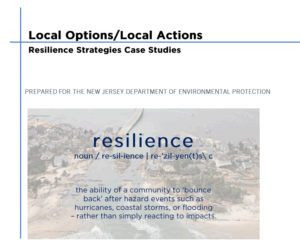
New Jersey Future and NJDEP release report of local options and actions for resilience
Blog
01/07/2020
Resilience planning in Medford
Blog

10/28/2014
Preparing for the Next Sandy Requires Facing Hard Facts
Op-Ed Articles

09/04/2013
Time for New Jersey to be Smarter than the Storm
Op-Ed Articles