New Jersey Future Blog
New Report Digs Deeper into Diversity in Morris and Monmouth Counties
January 29th, 2024 by Tim Evans
New Jersey is an expensive state, with among the highest housing costs in the country. It is also one of the most segregated states in the nation by both income and race, despite being one of the most racially diverse states overall. A new report from New Jersey Future explores the relationship between the enforcement of housing requirements, housing affordability, and racial and economic diversity, using a comparison between two demographically similar suburban counties—Morris and Monmouth—that followed different trajectories in complying with New Jersey’s affordable housing obligations. The findings of our analysis are included in “Breaking Barriers: A Comparative Analysis of Affordable Housing Compliance and Diversity in Morris and Monmouth Counties, New Jersey.”
Morris County municipalities had a head start in meeting affordable housing obligations. Our new report compares their progress to their counterparts in Monmouth County to chart New Jersey’s progress in promoting integration through affordable housing.
The New Jersey Supreme Court’s Mount Laurel decisions in the 1970s and 80s took on the issue of racial segregation by addressing the lack of housing options, eventually leading to a legal requirement for every municipality in the state to provide its fair share of the regional housing need for low- and moderate-income households. But the bureaucratic process set up in the wake of the court decisions, overseen by the Council on Affordable Housing (COAH), featured numerous loopholes via which municipalities could shirk their responsibilities to produce actual housing units. Monmouth County’s municipalities have been governed entirely by the Mount Laurel process, while a group of Morris County municipalities were the subject of a separate lawsuit, initiated in 1978, that predated the second Mount Laurel decision, giving Morris County a head start in compliance with affordable housing obligations.
Housing costs and racial segregation go hand in hand. Many towns use their zoning power to limit the variety of housing options available, allowing primarily single-family detached homes on large lots. The resulting lack of lower-cost housing options renders many places off-limits to households of modest means, particularly Black and Hispanic households, whose incomes tend to be much lower than those for other racial subgroups. Whether motivated solely by fiscal concerns or by race- and class-based prejudices, large-lot zoning often results in segregation by both income and race.
The report considers whether Morris County’s having been the subject of an earlier, separate lawsuit appears to have resulted in the county producing more affordable housing, or achieving greater reductions in racial and economic segregation, compared to Monmouth County. Analysis suggests that the lawsuit was effective; the municipalities of Morris County have outperformed those of Monmouth County in the subsequent decades, in terms of producing new affordable housing. Morris County’s increase in affordable housing was more broad-based than in Monmouth County, happening across all municipalities and not just mainly in the handful of places that had already been providing a disproportionate share of the county’s supply before the COAH process was instituted.
While both counties today remain whiter and wealthier than the state as a whole, Morris County increased in racial diversity and narrowed its gap with the statewide racial distribution at a faster rate than Monmouth County did between 1990 and 2020. This is particularly true with the counties’ Black populations; the Black population share increased in Morris County as a whole and in a majority of its individual municipalities (30 out of 39), while in Monmouth, the Black percentage dropped countywide and in 30 out of 53 municipalities.
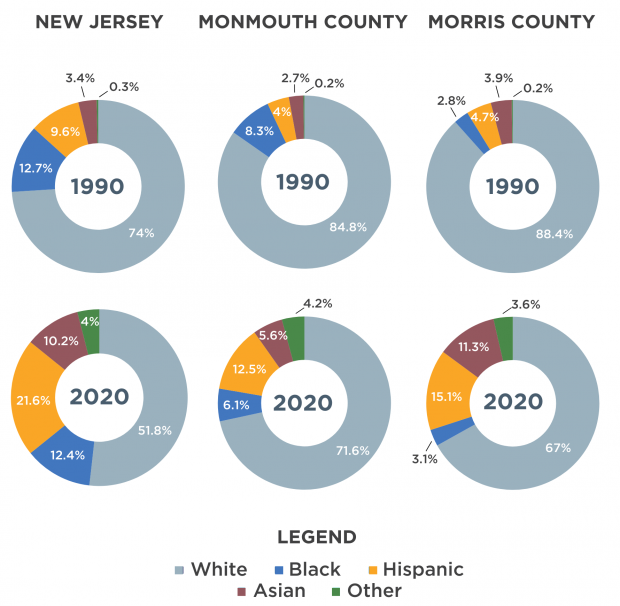
While Morris County and Monmouth County both remain whiter than the state overall, Morris has closed its diversity gap with the state faster than Monmouth has.
Morris County’s better progress toward reducing racial segregation at the local level is visible in the demographics of the two counties’ high schools, where changes in the Black and Hispanic student populations tended to mirror changes in the demographics of the general population. Morris County high schools generally saw their Black student percentages increase slightly, whereas in Monmouth County, more than half of high schools saw their Black student percentages decline. Hispanic student populations grew across the board in both counties, with the median Hispanic percentage being almost identical in the two counties’ high schools in 2023, though Morris County started from a lower baseline, in relative terms, in 1990. Progress was much less pronounced in both counties regarding income diversity, however, suggesting that the Mount Laurel process alone is simply insufficient to address the housing needs of households throughout the lower and middle parts of the income distribution.
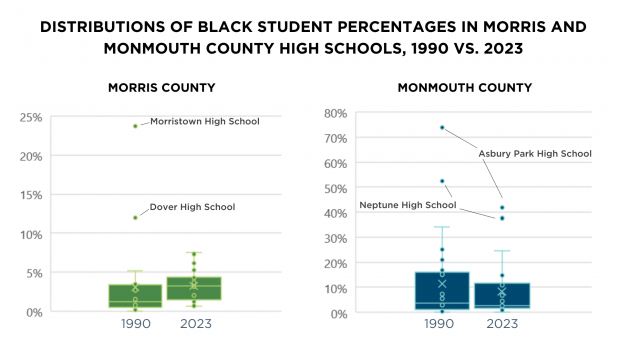
Morris County high schools generally saw their Black student percentages increase slightly, whereas in Monmouth County, the median Black student percentage among the county’s high schools actually declined.
The data examined in this report suggest that targeted enforcement of municipal requirements to produce more affordable housing actually results in more affordable housing. When presented with loopholes like those embedded in the COAH process that allow participants to evade their responsibility to provide housing options for lower-income households, many municipalities will avail themselves of the opportunity. But under more specific accountability, as illustrated by the Morris County lawsuit, towns can indeed be induced to produce a greater variety of housing options, thereby making themselves more affordable to a broader range of households and helping dismantle racial and economic barriers.
The report makes several recommendations for advancing the creation of more affordable housing, and more generally for mitigating local resistance to creating a greater diversity of housing types. Two of the recommendations are of particular interest in light of new legislation being proposed to revise or refine the Mount Laurel process:
- Retain effective enforcement of Mount Laurel obligations: Given the effectiveness of enforcement demonstrated by the report’s findings, it is important that any new legislation retains mechanisms for ensuring municipal compliance.
- Measure progress on affordable housing production and integration: The draft bill encourages greater transparency in how municipal affordable housing obligations are determined and how compliance is measured. Making data consistently available, both on affordable housing production and on some of the metrics of inequity that the Mount Laurel doctrine was designed to address, would advance this goal.
The report’s findings also suggest the need for a broader housing policy agenda to address affordability up and down the income spectrum. While the Mount Laurel process is a critical tool for providing homes for those most in need, the state should not rely on it exclusively as the means of making sure New Jersey remains affordable to a full range of households.
What You Read 2023 – A Message from the Editor
January 12th, 2024 by Sneha Patel
2023 was a year full of many unpredictable environmental events ranging from major rainfall to extreme heat to a collapsed highway overpass. Our daily newsletter “What We’re Reading” brings our readers the most up-to-date articles covering our New Jersey Future issue areas and major developments in the Garden State. We compile our daily digest by monitoring our favorite news sites and newsletters, and always bring you NJF in the news. Have an article you want to see included? Feel free to email suggestions to the NJF communications team (comms njfuture
 org) .
We’ve compiled the most-read articles from the year—no surprise that housing, flooding, and transportation were popular topics. Check out the top articles that have captivated our readers in 2023 and continue to keep current with news and developments by reading What We’re Reading!
– Sneha Patel
- Op-Ed: School segregation in NJ is not an accident (NJ Spotlight)
Despite being one of the most racially diverse states in the country, New Jersey remains stubbornly segregated at the local level. Persistent segregation in New Jersey’s schools has given rise to a lawsuit that seeks to compel the state government to develop a strategy for addressing it. Superior Court Judge Robert Lougy has issued a ruling that acknowledges that segregated schools are indeed a problem in many parts of the state, and while it does not call for any specific remedy, it finds that the state has a duty to correct it. - Lambertville City Council Approves Stormwater Management Ordinance (New Hope Free Press)
During Thursday evening’s council meeting, the City of Lambertville Council approved a wave of ordinances. Perhaps the most important one approved was the stormwater management ordinance. By approving this ordinance, the city will be able to fulfill requirements set by the New Jersey Department of Environmental Protection. - NJ lawmakers to consider slew of legislation about warehouses (NJ Spotlight)
New Jersey lawmakers are due to consider at least two dozen warehouse-related bills in the current lame-duck session in response to growing public calls for state action to cool the continuing warehouse construction boom across the state. “It certainly tells me that warehouses are still firmly on everyone’s radar screen,” said Pete Kasabach, executive director of New Jersey Future, a nonprofit that advocates for “smart growth” including the placement of warehouses where they help the economy without hurting the environment or their towns. “They continue to be problematic, and it shows that legislators are hearing from their constituents that this is a problem.” - What are the chances your home will flood? New N.J. law, revamped tool hope to help. (NJ.com)
Storm surges will not only likely worsen in New Jersey due to climate change in the future, but much of the consequences are already here. Some residents in mid-July saw it firsthand in towns that received a month’s worth of rain in three days. As part of the bill, S-3110, which was signed by Gov. Phil Murphy on July 3, the New Jersey Department of Environmental Protection will also look to revamp its publicly-available “Flood Indicator Tool” to make it more user-friendly for anyone to determine flood risks for themselves. - A Climate Change Success Story? Look at Hoboken (New York Times)
Let’s take a moment to give a shout-out to Hoboken. As climate change delivers more extreme weather and rising seas, communities across America are struggling to prepare. That’s not Hoboken’s situation. New York City has been spending billions on flood walls and breakwaters and is still contemplating giant gates to hold back rising tides, but it hasn’t done as much to deal with rain. Hoboken has been adding infrastructure to cope with both rain as well as sea-level rise. - Affordable housing quotas may get a sweeping overhaul. How it could impact your town (NorthJersey.com)
New Jersey towns may follow a new process to calculate their constitutionally mandated affordable housing quotas in two to three years, under a wide-reaching overhaul introduced during the lame-duck session by legislative leaders Monday. New Jersey needs to create more than 224,000 affordable rental units to meet its needs for extremely low-income families, according to a report by the National Low Income Housing Coalition. - Microforests in NJ: Turning developed urban spaces back to green (NJ 101.5)
To help bring new environmental and public health benefits to this Union County city, three microforests have been planted. A microforest is an innovative and effective method of tree planting and it increases carbon mitigation in urban areas like Elizabeth, said Phillips. With New Jersey being the most densely populated state in the nation, it has many urban areas, where microforests could be beneficial. - 3,300 NJ localities aren’t part of the state’s municipal governments. What are they? (Asbury Park Press)
There’s Double Trouble, The Alligator and Water Witch. Loveladies, Wickatunk and Success. They’re among more than 3,300 New Jersey localities tracked by the state that aren’t among the 564 municipal governments incorporated as cities, townships, boroughs, towns or villages within the state’s 21 counties. The curious names for many of these communities, neighborhoods and hamlets have interesting stories behind them, although some are in dispute and a few remain mysteries. - Extend NYC subway to New Jersey? (NJ Spotlight)
Rep. Bill Pascrell (D-9th) and Rep. Rob Menendez (D-8th) sent a letter to the Metropolitan Transportation Authority’s Traffic Mobility Review Board last week urging the agency to couple congestion pricing with the extension of the 7 train line to Secaucus via a new subway tunnel under the Hudson River. Such an extension — which would be the first MTA line to cross state borders — would allow commuters transferring from New Jersey Transit trains to directly access Grand Central Station and points in Queens.
Interested in staying on top of New Jersey news? Take advantage of this one time no cost sign up opportunity to receive our What We’re Reading newsletter for more on urban planning, water, and infrastructure in the Garden State!
Sustainable Water Management: Program Rundown of Municipal Options
December 18th, 2023 by Michael Atkins
The following feature was originally published in the December 2023 edition of NJ Municipalities Magazine, which has been relied upon by local government leaders, department heads and administrators for over 100 years. NJ Municipalities is read by over 6,000 readers each month. You can read an online version, or view the pdf of the print edition.
The future of New Jersey’s water relies on commitment to equitable decision-making to solve legacy water infrastructure issues like lead service line replacement, combined sewer overflows, coastal and riverine flooding, and upgrading water infrastructure. By working together to address the growing needs of our water systems, we can properly mitigate the stress they will face with growing and more frequent storms fueled by climate change, and ensure that natural and tap waters are free from contaminants to support healthy and resilient communities across the state. Learn more about the programs and resources available to assist municipal leaders in addressing these issues within their communities.
MS4 Primer
Over 90% of New Jersey’s waterways are considered impaired, and over 60% can be attributed to pollutants from stormwater runoff. In January 2023, the New Jersey Department of Environmental Protection (NJ-DEP) issued an updated Tier A Municipal Separate Storm Sewer System (MS4) Permit to address these water quality impairments and flooding issues.
The updated permit reflects a shift toward water-shed-level planning with the inclusion of a mandatory Watershed Improvement Plan requirement. For a highly developed state with large quantities of impervious cover, it is more important than ever to plan ahead to improve our water and protect all New Jerseyans from flooding events worsened by climate change.
New Jersey Future and One Water Consulting, LLC created an MS4 Primer to help municipalities understand the recent changes to the MS4 Permit and improve their municipal stormwater programs. The MS4 Permit and this primer provide a framework for water quality improvements and a regional approach to stormwater management in New Jersey. Contact our Mainstreaming Green Infrastructure Program Manager Lindsey Sigmund (lsigmundnjfutureorg) to get your copy of the MS4 Primer.
Looking for funding to get started on permit compliance? Apply for NJDEP’s Tier A MS4 Stormwater Assistance Grants. There is funding allocated for every municipality in New Jersey. Rolling deadline is December 31.
Funding Navigator
Water utilities around the state need funds, either low interest loans or grants for capital improvement projects to repair or enhance their systems. To help the most underserved water systems identify and navigate agency application processes to secure government funding, New Jersey Future has created its new and innovative Funding Navigator program.
Launched in April of this year, the Funding Navigator program specializes in offering meaningful community engagement and access to free professional technical assistance services to small-to-medium sized under-resourced public water utilities and municipalities. This is the first nonprofit statewide program committed to helping localities access funding for drinking water, wastewater, and stormwater needs. By coordinating with other providers such as New Jersey Department of Environmental Protection, Environmental Policy Innovation Center (EPIC), Syracuse University, and Moonshot Missions, NJF leverages a wide range of resources to help tailor unique funding application consultation to unique water infrastructure problems.
The federal Bipartisan Infrastructure Law allocates approximately $900 million over 5 years for water infrastructure improvements in New Jersey. The Governor and the Legislature also allocated nearly $300 million in American Rescue Plan Act funding for water infrastructure. New Jersey Future’s Funding Navigator program is designed to steer these funds, along with other state funding, to those water systems and municipalities that need it most. These funds are time limited, so it is crucial for municipalities to begin applying for funding. The Funding Navigator helps eligible municipalities and water systems by aiding with upfront application costs for engineering design and legal fees, community and stakeholder outreach, gap analysis report/presentation of water utility systems,
and funding application review and consultation.
Pursuing financial infrastructure support does not have to be a complicated and arduous journey. Navigating these streams of funding with the New Jersey Future Funding Navigator staff and partners can make for a smoother process. To learn more about our Funding Navigator program and step by step process working with municipalities and water utilities, please visit us at www.njfuture.org/new-jersey-funding-navigator/ or contact our Program Manager, Lee M. Clark (lclarknjfutureorg) .
Jersey WaterCheck
This data dashboard connects water consumers, utilities, and decision-makers with easy-to-understand information on drinking water and wastewater systems in New Jersey. This tool to tracks progress of local water/sewer utility and showcases success stories in infrastructure improvements.
The dashboard was created to serve Jersey Water Works, a statewide collaborative working on New Jersey’s water infrastructure challenges. Metrics on both the Shared Goals, and Benchmark Hub pages are categorized according to Jersey Water Works’ goals and subgoals, such as Effective and Financially Sustainable Systems, Wise Management and Spending, and Transparent Water Systems. Each metric on Jersey WaterCheck has a description that explains the information being shown, and things to keep in mind when reading it. From the home page of Jersey WaterCheck, you can learn about an individual water or wastewater system using the System Finder.
On a particular water or wastewater system page, metrics are displayed on cards that are organized based on “Communication Categories,” which were created specifically for this dashboard. Jersey WaterCheck provides granular utility level and state level actionable information that can help generate community support for decision making on water infrastructure needs. Visit www.njwatercheck.org.
SRF Equity Report
New Jersey Future recently published a report examining how funding reaches water systems of all sizes throughout the state, Improving a Program that Works: Prioritizing New Jersey Water Bank Projects in Disadvantaged Communities. The New Jersey Water Bank (NJWB), which finances water infrastructure projects, is a successful program that has provided over $9 billion in low-cost financing for water and wastewater projects. New Jersey Future partnered with the national Environmental Policy Innovation Center in producing the report, which analyzes NJWB awards and provides 10 recommendations to increase equity and effectiveness of the NJWB. Visit njfuture.org/research-reports/srfequity
Lead-Free New Jersey
Every water system in New Jersey must identify and replace all lead service lines by 2031. Jersey Water Works and Lead-Free NJ have resources for elected and municipal leaders to achieve this goal, thanks in part to the collaborative efforts of our diverse members.
Two resources of note include the Primer for Mayors, produced by the Lead in Drinking Water Task Force, and our Community Hubs, operated by Lead-Free NJ.
The Lead in Drinking Water Task Force, which provides policy recommendations to Lead-Free NJ and assists Jersey Water Works in supporting a community of state water leaders, advances statewide policy while empowering municipal and local leaders with the necessary information to ensure equitable, cost-effective, and efficient lead service line replacement through resources like the 2023 Primer for Mayors – Let’s Get the Lead Out of Our Drinking Water: Lead Service Line Efficiency Measures. This most recent edition includes 10 recommended efficiency measures to assist municipalities and water agencies to better inform and collaborate with their communities.
For more information, visit www.leadfreenj.org/community-work.
The Future of Housing in New Jersey
November 30th, 2023 by New Jersey Future staff
The following feature was originally published in the November 2023 edition of NJ Municipalities Magazine, which has been relied upon by local government leaders, department heads and administrators for over 100 years. NJ Municipalities is read by over 6,000 readers each month. You can read an online version, or view the pdf of the print edition.
By Chris Sturm and Michael Atkins
Housing shapes communities while communities shape the quality of life and access to opportunities for each of us. Local officials are on the front lines of housing development, shaping what kind of housing gets built, where it can be constructed, and the local roads and sidewalks residents use to get from their homes to everywhere else. Municipalities have the authority to adopt land use plans, set zoning codes, and create redevelopment areas and parking maximums that facilitate high quality places. Municipalities and counties have the transportation teams to design, pave, and maintain the streets and sidewalks that create the character of a community and determine if it is welcoming and safe for all users. If “home is where the heart is”, then housing is at the heart of a strong and inclusive New Jersey.
But the external challenges facing local leaders have become more complicated and more intense. The COVID-19 pandemic and climate change in particular have exacerbated the pressing issues of escalating housing costs, pedestrian safety, displacement of lower-income people, empty office space, and flooding, to name a few. Recent economic turmoil due to the pandemic only amplified these pressures—first demand and inflation drove up housing prices, and now high interest rates have made mortgage financing increasingly difficult.
As a nonprofit organization focused on land use and smart growth, New Jersey Future works to help communities emerge strong from crises. And together with many partners—including local and state government, developers, community activists, and environmentalists—we see housing as not only the center of much debate but as an important lever to advance strong, healthy, resilient communities for everyone.
Center-based housing development
Towns and cities that encourage a range of housing types in walkable neighborhoods and centers aren’t just revitalizing town and city centers for aesthetics. Successful downtowns and centers are converting abandoned strip malls, vacant shops, and empty office space to new housing, which provide municipalities with more reliable, steady, tax revenues, often without adding the costs of new students to their school district. The result is stronger tax ratables and dynamic live-work-shop places where residents enjoy local restaurants, parks and theaters. Towns should not overlook the benefits of providing mixed-use centers to their local residents, and enabling their residents to host friends and family at their favorite places to promote even further commercial activity.
Center-based housing development supports long-time residents as they undergo changes in life, but seek to remain close to their personal networks that provide them fulfilling opportunities to live full and meaningful lives. Consider empty nesters looking to downsize from their single-family home to age in place, and newly separated parents who want to continue to live in the same school district that their children attend. While occupancy rates for office and retail space have been weakened by post-pandemic hybrid work schedules and online shopping, the demand for center-based housing is robust, and growing as new generations, primarily Millennials and Gen Z, seek to live close to family, but with a modicum of urbanity to facilitate their hobbies and interests. Towns and cities that plan and zone for center-based housing create options for their community members undergoing life transitions, without forcing them to relocate.
Walkable places with a mix of housing and services simplify the way residents get between home, pick up their children from school, and make it to their next doctor’s appointment. Smartly designed, compact town and city centers can reduce commute times and allow people to accomplish multiple tasks within one trip, ideally returning time back to people by freeing them from commuting long distances in their private vehicles and sitting in traffic congestion.
Attainable housing
Rising costs of housing in New Jersey are a significant driver of the growing affordability crisis in the state. A 2021 Rutgers-Eagleton poll “found that 90% of New Jerseyans are worried about the cost of housing in the state, with 55% considering it a “very serious” problem.” It’s in New Jersey’s best interest economically, socially, and environmentally for our local leaders to provide stable and lower-cost housing options in their communities, so the state as a whole is more affordable. New Jersey’s high cost of housing has long had an impact on the state’s “brain drain”, the migration of highly educated individuals out of the state, due to the lack of housing access.
Developing additional housing also eases pressures on lower-income households. In the absence of new development or quality redevelopment, affluent households will outcompete lower-income households, fueling gentrification and triggering displacement of long-time residents. Housing affordability is not just about out-migration or displacement though. It raises basic quality-of-life questions like: What could households do with an additional $100 a week? What would commuters do with an additional two or three hours back in their lives?
Too many hard-working residents are unable to rent, let alone buy, in the communities in which they work. Teachers, healthcare professionals, and service workers of every variety, are commuting longer, often in their private automobile, to their places of work. “Across the state, municipalities that facilitate solutions to promote sustainable housing opportunities for all workers will see a ripple of positive effects for their communities,” observed Montclair Mayor Sean Spiller, who also serves as president of New Jersey Educators Association. “Making sure educators, and educational support professionals, and their families are able to live in the communities they serve if their circumstances allow, is a win-win for educators, students, and communities as a whole,” Spiller continued. “Aside from policies that fairly compensate hard working, vital public servants, like educators, New Jersey cities and towns should think holistically about the benefits of promoting diversity and sustainability within their communities, and as we’ve done in Montclair, take legislative action to achieve and preserve that diversity.”
Climate change and housing
The manner in which we build new and improve existing housing must assist in our broader climate change mitigation and adaptation efforts. New developments must be sited out of flood zones to foster resilience, safeguard public health and minimize property damage. They can be designed to reverse our mismanagement of stormwater. Sprawling developments, big box stores, and highly-developed downtowns have laid vast impermeable surfaces across our state. Rainwater runs off of these surfaces, pollutes our water supplies, and flooding worsens. Today, new development and conscientious redevelopment is beginning to rectify this issue by installing green infrastructure facilities like street trees, bioswales, and rain gardens. Municipalities can not only comply with new state regulations for stormwater management, they should embrace and encourage them as vital tools to address a growing risk.
Finally, compact densities can reduce car dependency, shorten trips, cut emissions, and improve air quality. By building a network of places well-linked by public transportation, we can ensure that New Jersey has its best foot forward and is ready to face the challenges of climate change with minimal loss of lives or property values.
The future of housing in New Jersey
Since its formation in 1987, New Jersey Future has steadfastly advocated for center-based development and smart redevelopment projects in accordance with our statewide goals of balancing development and preservation and spurring equitable economic growth. While we have had an eye to statewide progress, it is local municipal leaders and planners who have the tools and powers to encourage development and redevelopment that can deliver more housing that is affordable, inclusionary, climate resilient and located in walkable, people-oriented centers that increase commercial activity and improve public health.
But local community planning and zoning is tricky and complicated. Even as we celebrate local success stories (see this year’s Smart Growth Award winners in the sidebar), we know municipal leaders often struggle to redevelop and add housing supply to our already dense and well-connected state. Many of our partners in government, nonprofit, and the private sector are likewise interested in identifying and constructing solutions out of the current crunch.
Over the coming months, New Jersey Future will be convening partners and stakeholders to envision future housing development in our state that is equitable, affordable, resilient, and diverse. Through a collaborative process we seek to identify practical, actionable steps to get there including everything from understanding and elevating municipal needs, to state planning and policy, to partnering with low and moderate-income residents. We encourage readers to stay tuned as New Jersey Future and its partners work together on a set of solutions and publicize our findings in Spring 2024.
To inform that conversation, New Jersey Future is circulating a simple survey to collect the perspectives of municipal leaders, community members, planners, architects, and developers. We invite you to take 10 minutes or less and share your thoughts on the pressures, successes, and challenges you and your town are facing as we confront this together. Survey available online.
The NJ State Development and Redevelopment Plan is Being Updated – Where and How Should New Jersey Grow? Add Your Voice!
October 12th, 2023 by Chris Sturm
The NJ State Planning Commission is hosting a series of eight webinars in October to gather input on how to update the New Jersey State Development and Redevelopment Plan. Last adopted in 2001, the State Plan provides a comprehensive framework intended to guide future development, redevelopment, conservation, preservation, and restoration efforts in the state of New Jersey.
Each webinar focuses on one to two of the State Plan’s existing high-level goals and strategies or one of the two proposed new goals for Climate Change/Resilience and Equity/Environmental Justice. The webinars allow for high-level input through polls and a chat function. Interested parties may also submit written comments at this email (stateplancommentssosnjgov) .

Launching the Next State Plan session at the 2023 NJ Planning and Redevelopment Conference. State Planning Commission members in attendance included Tom Wright, Edward McKenna, Elizabeth Terenik, Stephen Santola, Bruce Harris, and Danielle Esser. Photo by Frank H. Conlon
Launching the Next State Plan was a session held at the 2023 Planning and Redevelopment conference and explored how to best update the State Plan to better reflect the present conditions and future outlook of New Jersey.
To learn more about the State Plan update, to register for a session, or view recordings of past sessions, visit www.publicinput.com/njstateplan. We will share information on additional opportunities to participate in the State Plan update process when available.
In the meantime, the 2023 Planning and Redevelopment Conference workshop, Launching the Next State Plan, explored how to best update the State Plan to better reflect the present conditions and future outlook of New Jersey.
Open Space, Historic and Cultural Preservation Strategies in an Updated State Plan
Date: Tuesday, October 17, 2023
Time: 9 a.m. – 11 a.m. (Eastern Time)
In this two-hour webinar, participants will hear a panel discussion on the State’s desire to enhance, preserve and use historic, cultural, scenic, open space and recreational assets by collaborative planning, design, investment, and management techniques. Our expert panel will provide feedback on updating the current language in Goal 7:
- Goal #7: Preserve and Enhance Areas with Historic, Cultural, Scenic, Open Space and Recreational Value
Panelist:
Julie Hain, Executive Director – South Jersey Cultural Alliance
Captain Bill Sheehan, Riverkeeper – Hackensack Riverkeeper
Vincent Mann, Chiefmann – Ramapough Land & Cultural Foundation
(Additional Palnelist to be announced)
Establishing Goals for Social Justice in an Updated State Plan
Date: Thursday, October 19, 2023
Time: 10 a.m. – 12 p.m. (Eastern Time)
In this two-hour webinar, participants will hear a panel discussion for establishing new goals and strategies for social justice in the updated NJ State Plan and the topic’s influence on all other Goals in the State Plan. Our expert panel will provide feedback on establishing language in new Goal 9:
- Goal #9: Prevent the Concentration of Adverse Environmental Impacts in Overburdened Communities
Panelist:
Deidre Belinfanti – Garden State Equality
Dr. John E. Harmon, Sr. IOM – African American Chamber of Commerce of NJ
(Additional Palnelist to be announced)
Establishing Goals for Climate Change & Resilience in an Updated State Plan
Date: Friday, October 20, 2023
Time: 9 a.m. – 11 a.m. (Eastern Time)
In this two-hour webinar, participants will hear a panel discussion for establishing new goals and strategies for climate change and resilience in the updated NJ State Plan and the topic’s influence on all other Goals in the State Plan. Our expert panel will provide feedback on establishing language in new Goal 8:
- Goal #8: Address the Negative Impacts of Global Climate Change
Panelist:
Paul Drake, Regional Public Affairs – PSE&G
Kerry Kirk-Pflugh, Executive Director – NJ Conference of Mayors
(Additional Palnelist to be announced)
Economic Development and Workforce Strategies in an Updated State Plan
Date: Monday, October 23, 2023
Time: 10 a.m. – 12 p.m. (Eastern Time)
In this two-hour webinar, participants will hear a panel discussion on the economic development and workforce strategies in the current NJ State Plan and their influence on revitalizing the State’s cities and towns. Our expert panel will provide feedback on updating the current language in Goals 1 and 3:
- Goal #1: Revitalize the State’s Cities and Towns
- Goal #3: Promote Beneficial Economic Growth, Development and Renewal for All Residents of New Jersey
Panelist: (To be announced)
Sound & Integrated Planning in an Updated State Plan
Date: Tuesday, October 24, 2023
Time: 2 p.m. – 4 p.m. (Eastern Time)
In this two-hour webinar, participants will hear a panel discussion on the Plan Endorsement process, planning based on capacity analysis and integrating planning with investment decisions at all levels of government and in the private sector. Our expert panel will provide feedback on updating the current State Plan language in Goal 10:
- Goal #10: Ensure Sound and Integrated Planning and Implementation Statewide
Panelist: (To be announced)
Green Infrastructure in the Garden State: Stormwater Research in the Delaware River Watershed
September 20th, 2023 by Brooke Schwartzman
In 2020, the New Jersey Department of Environmental Protection (NJDEP) updated the Stormwater Management Rules, which now require that municipalities incorporate green infrastructure into major development projects. In many areas of the state, this relatively new policy change has meant a significant departure from the way that stormwater management was approached previously. New Jersey Future (NJF) sought to explore the impact of the rule change on green infrastructure implementation in New Jersey’s Delaware River Watershed region.
Stormwater is water that accumulates on land either through rain or snow, but instead of soaking into the ground as it would in nature, it accumulates into stormwater runoff. Poorly managed stormwater can result in a host of negative consequences like flash flooding and water quality issues caused by nonpoint source pollution. Green infrastructure (GI) is a solution to addressing stormwater runoff. This umbrella term includes any structure or installation that manages stormwater by protecting, restoring, or mimicking the natural water cycle. Consequently, GI decreases impervious cover and the stress on outdated stormwater infrastructure and effectively filters said water before inundating it back into the ground.
New Jersey has several regulatory structures in place to control stormwater as part of the National Pollutant Discharge Elimination System (NPDES). One such structure is N.J.A.C. 7:8, commonly known as the Stormwater Management Rules, which requires municipalities to hold a Municipal Separate Storm Sewer System (MS4) permit. Municipalities receive the MS4 permit after developing a stormwater program and meeting Statewide Basic Requirements (SBR) which set minimum standards for controlling stormwater pollution and inundation. One of the SBRs is for municipalities to develop a Stormwater Control Ordinance (SCO) that codifies compliance with N.J.A.C. 7:8. The SCO is then applied to all major development and redevelopment projects within the municipality. When NJDEP makes an amendment to their Stormwater Management Rules, municipalities are required to reflect that update in their SCOs within one year of the effective changes. Stormwater data for all NJ municipalities is available online through Jersey WaterCheck.
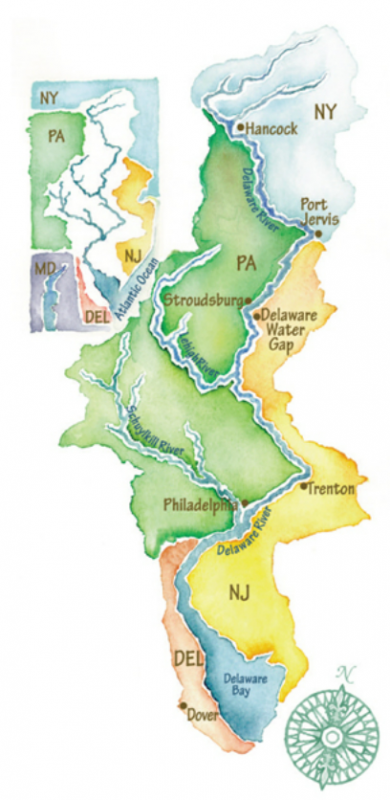
The Delaware River Basin. Source: Delaware River Basin Commission
In spite of its many benefits, green infrastructure is still underutilized in New Jersey. NJDEP sought to address this by making changes to the Stormwater Management Rules in 2020 that officially took effect in March 2021. The biggest difference between the Stormwater Management Rules then and now is how SCOs are expected to regulate GI. Prior, the minimum amount of GI that SCOs had to have demanded was “the maximum extent practicable”, leaving loopholes for the installation of green infrastructure. Now, SCOs require that GI be used for every major development project. Additionally, as part of New Jersey Protecting Against Climate Threats (NJ PACT), updates to the stormwater management rules went into effect on July 17, 2023, due to the Inland Flood Protection Rules. Further updates are expected as part of Resilient Environments and Landscapes (REAL). NJDEP released a model stormwater ordinance to guide municipalities as they amend their SCOs. This ordinance uses minimum standards but municipalities are free to make those standards stricter. NJF released their own enhanced model stormwater ordinance in 2021 to demonstrate ways in which municipalities could go above and beyond minimum requirements, such as including the definition of minor development and reducing the threshold for major development in their SCO. Municipalities that implement an enhanced model ordinance are eligible for Sustainable Jersey points.
New Jersey Future wanted to understand how the updated SCOs are impacting the implementation of green infrastructure, specifically in the Delaware River Watershed. The Delaware River Watershed is an interesting case study because it intersects with over 200 municipalities in New Jersey and several other states. 30 municipalities were selected for outreach. Communities were more likely to be targeted if they had populations especially vulnerable to flooding impacts, had certain kinds of infrastructure present suitable for complete and green streets, or were located in certain ecological regions. 27 of the 30 researched municipalities have updated their SCO and posted it online. Only one municipality, Edgewater Park Township, adopted above-minimum stormwater requirements language in their SCO. Note that even though a municipality adopted the minimum requirements language it does not necessarily mean they are installing the minimum amount of GI, as evidenced by Camden later in this article. Of the 30, NJF interviewed 10 municipalities.
Several overall trends were revealed when analyzing the municipalities’ responses. Small municipalities were less likely than large ones to require GI prior to the rule change, but almost all municipalities regardless of size already had GI present. The most common types of green infrastructure implemented are retention and infiltration basins, rain gardens, tree plantings, and permeable cover. Some municipalities have incorporated the impacts of the updated SCO into their master plan. Most are still in the process of building their stormwater infrastructure maps, another new requirement of the updated Stormwater Management Rules. All 10 municipalities interviewed are working with outside consultants for the task. Most municipalities have approved little to no projects under the new SCO either because there is little new development going on or because current projects are legacied under the previous rules. The municipalities that engaged stakeholders about GI did so primarily through regular council meetings; there have been a range of reactions from the general public. By far the most common barrier to meeting the new SCO requirements cited was funding even though most of the municipalities had already received stormwater grants from NJDEP. It also became clear through NJF’s interactions with municipalities that many have limited capacity to handle the additional work that is born out of implementing the updated SCO, which demonstrates that additional technical assistance is needed.
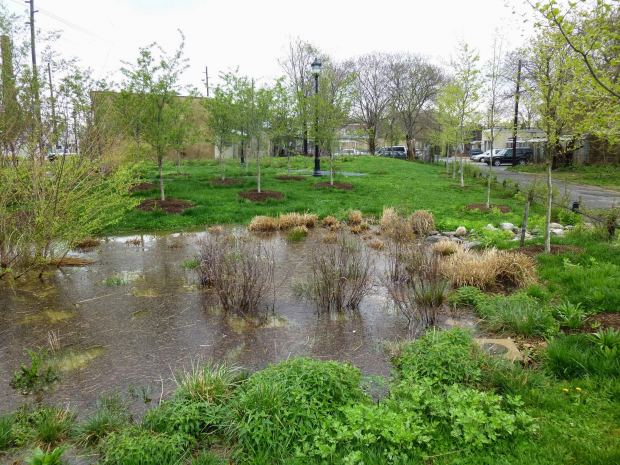
Waterfront South Rain Garden, Camden. Source: Rutgers GIS web map of Camden Green Infrastructure Projects
One municipality that is a good example of what it means to build an expansive green infrastructure system is the City of Camden. Even though Camden’s SCO is using the minimum requirements language set by NJDEP, the city’s actions have gone far beyond that. The city takes part in the Camden SMART initiative founded in 2011 and is made up of several organizations and stakeholder groups including Camden Community Partnership (CCP), the City of Camden (City), Camden County Municipal Utilities Authority (CCMUA), Rutgers Cooperative Extension Water Resources Program (RCE), New Jersey Tree Foundation (NJTF), and the NJ Department of Environmental Protection (NJDEP). Camden SMART is responsible for at least 50 GI projects. The city is filled with tree plantings, rain gardens, stormwater planters and rain barrels. Over 60 million gallons of stormwater have thus far been captured. Between the additional GI projects coming up and the new street bump outs and green curb lines that will be installed as a response to the new SCO requirements, the city aims to eventually capture 30 million gallons annually. Camden is also adept at engaging community members via regular city-wide meetings on upcoming GI projects, sustainability events, community rain gardens, and rain barrel workshops. Two challenges face Camden in the expansion of their GI network: the large amount of impervious surfaces and lack of available space, and litter which has the potential to interrupt the water inundation cycle if too much accumulates in green infrastructure installments. To learn more about how Camden is leading the charge in green infrastructure, visit their interactive map of GI projects.
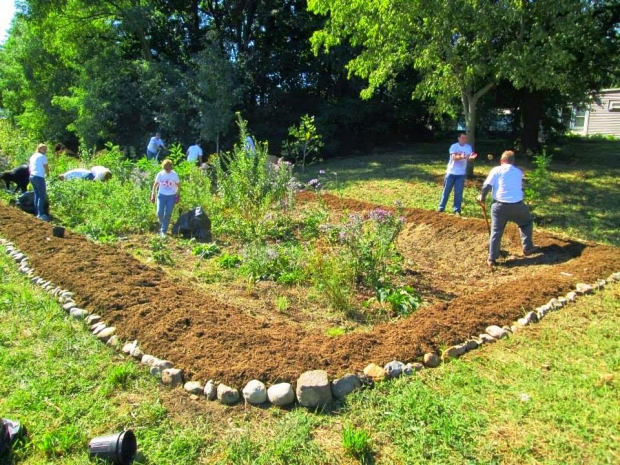
29th Street Biobasins, Camden. Source: Rutgers GIS web map of Camden Green Infrastructure Projects
The changes made by NJDEP to the Stormwater Management Rules bring New Jersey one step closer to achieving climate resilience. Municipalities are working toward incorporating the amendments into their SCOs, but are in need of more support. One strategy to increase dedicated stormwater management funding is to explore the implementation of a stormwater utility. The increased workload and expenses associated with the initiative put additional strain on municipalities. In spite of these challenges, places like Camden demonstrate how powerful green infrastructure can be when local leaders are committed to its installation.
Accessing New Federal Funding for Active Transportation Projects: Camden County Got a Bunch, How Can You?
September 18th, 2023 by Zeke Weston
The Infrastructure Investment and Jobs Act (IIJA) was signed into law by President Joe Biden on November 15, 2021, investing $1.2 trillion in America’s infrastructure. From the IIJA, New Jersey municipal, county, and state governments have the opportunity to tap into once-in-a-generation funding programs, many of which support safe and accessible transportation alternatives for walkers, bikers and rollers. Camden County took advantage of the IIJA opportunity to secure $19 million in federal funding to design and build a new 3.8 mile section of the LINK trail. These new trail segments will connect existing trail segments from the Benjamin Franklin Bridge in Camden to Cooper River Park in Pennsauken.
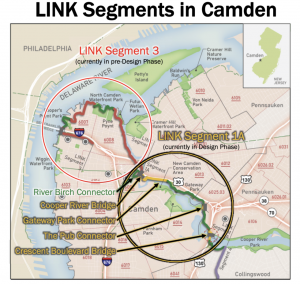
Camden City LINK Trail Map courtesy of the Bicycle Coalition of Greater Philadelphia
The Camden County LINK Trail is a 34-mile multi-use, off-road trail that, when completed, will connect 17 communities in Camden County and serve as the southeast section of the Circuit Trails Network in New Jersey. The LINK is part of a growing network of trail segments that are expected to eventually connect Philadelphia, PA to Cape May, NJ. Funding for the 3.8 mile Camden LINK was awarded from the Rebuilding American Infrastructure with Sustainability and Equity (RAISE), a discretionary grant program from the IIJA. RAISE grants can be used to invest in road, rail, transit or port projects, but Camden took advantage of it to expand their trail network, demonstrating that there are opportunities for active transportation projects to access funding.
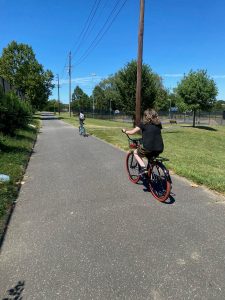
Two kids riding their bikes on an existing LINK Trail segment through East Camden
“Hundreds of people will be able to walk less than ten minutes to new public amenities,” explained Justin Dennis, Camden Program Director with the Trust for Public Land (TPL), on the importance of the Camden LINK. Many Camden residents will be able to walk or bike directly onto the LINK from their neighborhood. From there, the travel and recreation opportunities are vast and include access into downtown and numerous parks throughout the city. The safety of non-motorized users will be prioritized, so that residents can comfortably and safely rely on the trail network. Therefore, the Camden LINK Trail is not simply a recreational amenity, but more importantly an accessible and equitable regional connector. Dennis believes that the “LINK will improve the mental health and social cohesion of the community.” Project boosters hope the LINK Trail will be more than a leisure-oriented mixed-use path, and instead serve as an arterial transportation network for folks to get to and from their destination of choice without the need for or reliance on a car.
Felix Moulier, Project Manager for the Saint Joseph’s Carpenter Society, an East Camden non-profit that focuses on affordable housing and neighborhood development, grew up in Camden and recently moved back to live and work. The more Moulier learns about the LINK trail, the more he understands its value. “The trail’s influence on beautification is an instant win because it has an immediate impact,” he claimed. The creation of trail networks includes trees, flowers, benches and other components that alter the landscape of the community, in turn improving perception of the neighborhood among local residents and visitors. Households and individuals are anticipated to find green neighborhoods more welcoming to rent or buy property, or simply to enjoy local shops, museums, eateries, and other public amenities. Importantly, city residents will no longer have to travel out of their neighborhood to access public green spaces, improving the quality of life for the community. Thus, it serves as an example of how well-developed active transportation networks can positively influence communities in various ways, including providing reliable access to green and open spaces and connecting residents to their local waterway.
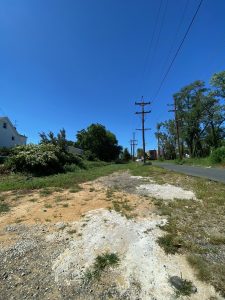

The picture on the left is of an undeveloped trail segment in East Camden, while the picture on the right is of a developed trail segment on the same road.
Francisco Moran, ex-Camden City Council President and Mayor, expressed that multi-use trail networks are “particularly important in a city like Camden, where one-third of the residents don’t own cars.” The new LINK Trail segments will better enable community members who don’t own cars or don’t want to drive, to travel around the city. Residents will not have to rely on cars to get around, rather they can walk or bike to their destination of choice. The lack of bicycle and pedestrian infrastructure in the city has been a major safety concern for folks attempting to get around without a car. The LINK will ensure pedestrians and cyclists have a safe and reliable route to travel through the city.

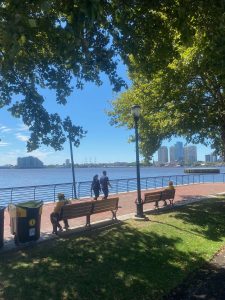
LINK Trail segment along the Delaware River in Camden
IIJA Funding Opportunities
The expanded grant opportunities provided by the IIJA, like the RAISE program that will fund the Camden LINK, will not last forever. IIJA funding is only available through fiscal year 2026 and the application process is extensive. Competitive projects often require feasibility studies, a planning and design process, and various other components that cannot be rushed. Therefore, the time to begin identifying and thinking about potential projects is now. In addition to RAISE, there are multiple IIJA programs that can be accessed for active transportation and complete streets initiatives. The Safe Streets and Roads for All competitive grant program funds Vision Zero initiatives that seek to make access and mobility safer for non-motorized users. The national $5 billion program can be used for active transportation projects that are likely to significantly reduce transportation related deaths and injuries. The Transportation Alternatives Set-Aside (TASA) is a program that has more than doubled in size under the IIJA that can be used for active and multimodal transportation projects, including bicycle and pedestrian facilities and complete streets. The process for applying to the IIJA programs begins long before the respective program deadline. Competitive applications include planning and feasibility studies to demonstrate project viability. This may require applicants to hire a consultant and is just one of numerous application requirements. Therefore, it is important to begin the planning process as soon as possible. Application costs may be covered by government agencies (see below), but even if not, they can unlock large grants. To gain a better understanding of the IIJA program and its potential uses, visit the State of NJ IIJA homepage. For help getting started on applying to the IIJA programs, visit your region’s Metropolitan Planning Organization’s (MPO) IIJA webpage: the Delaware Valley Regional Planning Commission (DVRPC), the North Jersey Transportation Planning Authority (NJTPA), or the South Jersey Transportation Planning Organization (SJTPO). Additionally, folks interested in learning more about how to access the active transportation opportunities in New Jersey can email NJDOT’s Office of Bicycle and Pedestrian Programs (BIKEPEDdotnjgov) or the New Jersey Bicycle and Pedestrian Advisory Council (BPAC) (bikepedejbrutgersedu) for more information.
For help determining who to reach out to and how, feel free to email New Jersey Future’s Land Use Policy Coordinator, Zeke Weston (zwestonnjfutureorg) .
Creating Safe Communities and Options for Walk-Bike-Ride Transportation in New Jersey
August 8th, 2023 by Sneha Patel
“Every decision about transportation is an opportunity to build a clean, healthy, and more prosperous future,” declared Christopher Coes, Assistant Secretary, U.S. Department of Transportation (DOT) as he provided prepared remarks to open the session “Delivering Walk-Bike-Ride Transportation in New Jersey” at the 2023 Planning and Redevelopment Conference co-hosted by the NJ Chapter of the American Planning Association and New Jersey Future.
New Jersey has an exceptional opportunity in the transportation sector to expand walk-bike-ride options in many communities, especially in the face of the large increase in federal funding for transportation, and the unlimited discretion the state has for the use of these funds. The Bipartisan Infrastructure Act allowed DOT to award $1 billion dollars through Safe Streets to create safe corridors, and $4.5 million over the next five years to improve efficiency by providing more affordable public transit. The number of pedestrian fatalities has climbed to the highest levels since 1981, and during 2020-2022 more individuals died in rural, Black, and brown underserved communities, stressing the need for an infrastructure shift to prioritize safety. Crowded streets and large populations in urban neighborhoods can make pedestrians feel unsafe, and the lack of sidewalks along high-speed eight lane stroads in suburban neighborhoods elicit the same feeling. Emphasizing pedestrian safety and encouraging walk, bike, and ride options requires committed local leadership to seek and earn allocated resources and funding for their communities.
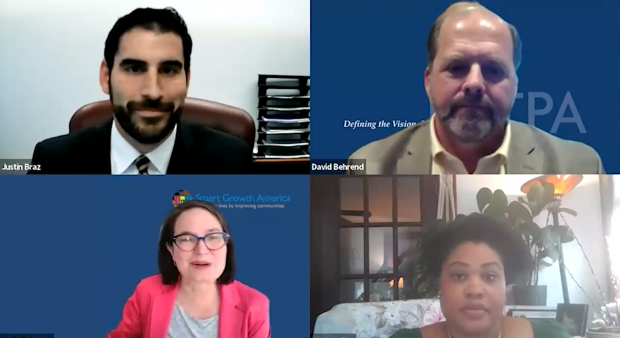
The virtual plenary Delivering Walk-Bike-Ride Transportation in New Jersey at the 2023 NJ Planning and Redevelopment Conference. Top from left to right: Justin Braz, Assistant Commissioner for Transportation Policy and Chief of Staff, New Jersey Department of Transportation; David Behrend, Executive Director, North Jersey Transportation Planning Authority (NJTPA). Bottom from left to right: Beth Osborne, Vice President for Transportation and Thriving Communities, Smart Growth America; Nicole Miller, Principal, MnM Consulting.
The session was moderated by Beth Osborne, Vice President for Transportation and Thriving Communities, Smart Growth America. Panelists offered their insights on the successes and challenges of implementation at the local level. They included: David Behrend, Executive Director, North Jersey Transportation Planning Authority (NJTPA); Justin Braz, Assistant Commissioner for Transportation Policy and Chief of Staff, New Jersey Department of Transportation; Nicole Miller, Principal MnM Consulting; and Christopher Coes Assistant Secretary, U.S. DOT.
Keynote speaker Christopher Coes described the federal government’s strategy for decarbonization and the ambitious goal of net zero carbon emissions nationwide by 2050. Transportation accounts for the major share of U.S greenhouse gas emissions, which is why the DOT, Environmental Protection Agency, and the Department of Housing and Energy have entered the first known memorandum of understanding (MOU) to decarbonize the transportation sector, releasing the U.S. National Blueprint for Transportation Decarbonization to assist states and communities. He stressed the importance of land use in increasing convenience for individuals through improved community design. Schools, job centers, and stores should be in proximity to each other to reduce commute burdens and expand opportunities for alternative transportation.
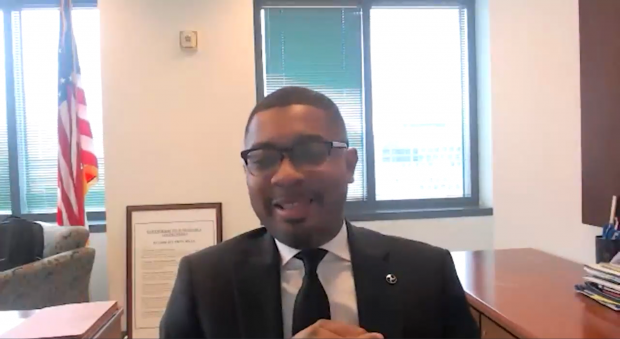
Keynote speaker Assistant Secretary Christopher Coes with the U.S. Department of Transportation during the virtual plenary at the 2023 NJ Planning and Redevelopment Conference.
Providing technical assistance to communities is necessary to achieve meaningful results. As part of the Thriving Communities cohort, East Orange has been selected as the first participant to receive hands-on technical assistance to connect the communities divided by I-280. Coes recognized that land use needs to be at the forefront of improving transportation infrastructure, adding that DOT provides developing tools and research to explain the connection between carbon emissions and land use to better inform their transportation policies.
“In the next 20 years, the Department of Transportation may be called the Department of Mobility,” Justin Braz mused. He noted increased funding and staff at NJDOT to liaise with communities and provide community members with multiple opportunities to move around. Increasing bikeways and trails and improving sidewalks are crucial to creating livable walkable communities. Braz highlights the seriousness of pedestrian safety and their focus at NJDOT on highway safety. He noted the initial data for 2023 for NJ has been positive; as of June 2023 the fatality rate is down 22% which is an improvement, but conceded “one death is one too many.”
David Behrend described the shift in federal funds from highway to public transit, such as electrifying bus fleets and transit improvements. He explained, “Everyone is rowing in the same direction right now, we want to take advantage of it when we can.” The North Jersey Transportation Planning Authority (NJTPA) aims to create the first-ever regional active transportation plan to improve bike and pedestrian mobility and safety. Behrend pointed out the need for “low-stress facilities,” where pedestrians feel it’s safe and convenient to walk, bike, or ride without the high traffic of cars. One key project Behrend emphasized was developing pathways like the Morris Canal Greenway, a 111-mile historic route cutting across the state from the Delaware River to Hudson County and connecting six counties. Behrend noted, “with Infrastructure Investment and Jobs Act (IIJA) funding, all the existing programs have gotten a degree of additional funding which …allows for more and larger projects.”
“Land use is key, but only comes after an internalized shift,” Nicole Miller declared, speaking on the difficulties of engaging people in slow-moving transportation improvement efforts and the potential rejection of such radical change. A perspective shift can be difficult when the ideal concept of the “American Dream” pressures households into single-family homes with two-car garages. She expressed “car-centric design has eroded urban centers, engrained a reliance on vehicles, promoted less-efficient energy and land-use, and unhealthily tied our economy to fossil fuels.” The cost of transforming the transportation sector cannot be ignored, she admitted, but “that cost must be measured against the lives lost, increased emissions produced, inefficient energy and land use, fewer housing options, and health concerns.”
With the shifting culture and more complex challenges of today, programs that weren’t created for the present ideology have to evolve. Braz described reshifting priorities to focus on long-term plans and the importance of committing to a full Complete Green Streets policy, with priority granted to projects that can be completed in two to three years.
Regional and local leaders should have a detailed plan that identifies specific needs to take advantage of existing funds. Behrend highlighted the NJTPA’s local demonstration project library for communities to access materials to test a temporary project setup and survey their impact. Braz reminded viewers not to overlook the value in targeting areas that only require minute fixes to address concerns like broken streetlights or weathered roads, in turn building community support behind quick improvements.
Shifting the attention towards public transportation can be done by involving community members, increasing public transportation options, and adding cost-friendly electric vehicles for younger people. Spreading awareness that increasing highway width does not decrease congestion, rather it only induces further demand and begets greater congestion. Cars have to be the most burdensome option, and walk-bike-ride should be better, cheaper, and faster Nicole Miller asserted. She continued that taking the train to work and entertainment centers “are sacrifices that people have to make, and part of the problem is we need a revised vision to make radical change.”
Rethinking Colonial Narratives and Transforming Native Insight into Actions: Indigenous Preservation of History
July 20th, 2023 by Sneha Patel
“Lenape means ‘the original human’, and that is where we need to get back to,” Chief Vincent Mann expressed, adding, “[reconnecting with the land] would provide us a way to encourage the people of tomorrow to take what we are sacrificing to create for them to further the future.” Indigenous people have a rich history of interacting in harmony with the environment. Colonialism commodified nature and continues to overshadow the indigenous history that existed in the Hudson Bay, and severed modern society from the ways of life that sustained pre-colonial populations. Panelists at a session dedicated to the subject at the 2023 Planning and Redevelopment Conference suggested creating a cultural interpretation center that preserves native history, through immersive teaching and community formation, as the start of a new strategy in facing a changing climate, while providing historical context on the Hudson Bay estuary and its ecosystem.
Moderated by Nagisa Manabe, Director of Development, Ramapough Culture and Land Foundation. The 2023 Planning and Redevelopment Conference session “Challenge Established Colonial Narratives of this Region’s History and Transform How We Communicate and Preserve indigenous History” recollected the painful past of native people that lived in the Hudson Bay area, and the importance of rewriting colonial history to disclose indigenous truths. The speakers Kerry Hardy, Historian, Lead Researcher and Cartographer at the Public History Project; Jack Tchen, Professor and Director, Clement Price Institute of Rutgers University Newark; Vincent Mann, Chief, The Turtle Clan of the Ramapough Lenape Nation; discussed the important role New Jersey indigenous communities can play in our region’s development and ensuring a resilient and equitable New Jersey.
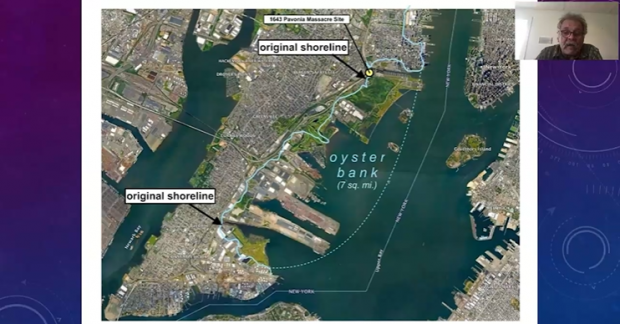
Kerry Hardy, Historian, Lead Researcher and Cartographer at the Public History Project, speaking about the Hudson Bay and oyster bank during the virtual session, Challenge Established Colonial Narratives of this Region’s History and Transform How We Communicate and Preserve indigenous History, at the 2023 NJ Planning and Redevelopment Conference.
The Hudson Bay area was a natural source for oyster, clam, fish, and waterfowl resources that provided enough protein to sustain humans through the winter season. Native groups, such as the Munsee/Mohican, Hackensack, Raritank, Assunpink, Lechauwitank, and Minisink, navigated the Minisink Path 100 miles or more to the mouth of the Hudson River. Cheesequake, at the mouth of the Hudson, became a mecca and gathering site for native populations, where ceremonial council fires were held. Today, massive shell deposits hint at Cheesequake being once a major social center in indigenous life.
New Jersey’s estuary and tributary rivers, such as the Passaic and Hackensack River, previously held a seven mile wide oyster bank. Colonization spurred the conversion of wampum shells into currency for fur trade. Jack Tchen reflected “During this brief period of time we go from millennial uses of the bioregion as a cultural, food, and lifeways commons, to settler colonialism by turning natural resources of the region into a commodity marketplace.” Genocide and industrialization have left the original oyster bank largely devoid of natural resources and buried under a defunct railyard. Today, approximately half of the original oyster bank is covered by Liberty State Park.
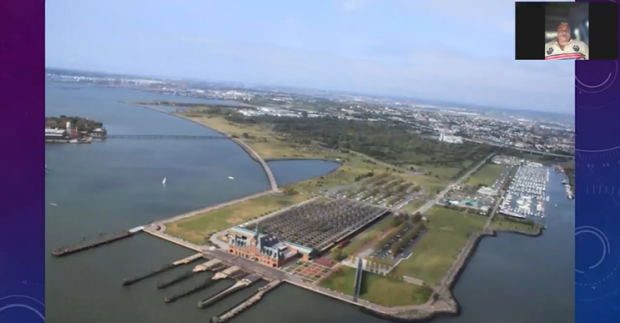
Vincent Mann, Chief, The Turtle Clan of the Ramapough Lenape Nation, speaking during the 2023 NJ Planning and Redevelopment Conference with image of Liberty Park spanning approximately half of the original oyster bank.
Chief Mann remarked on the way that land and people hold the suffering of the violence that took place. The land that once forced migration of indigenous people became the entry point for millions of immigrants into the United States of America. “When you look at the Liberty State Park, it is not just the destruction you see, but the ability to replant the seed. To have that seed be something that can prosper and benefit all of humanity by telling the story of this land prior to contact, and telling the story of enslavement,” Chief Mann reflected.
Chief Mann proposes a cultural interpretive center to recount the history of America before it became the United States, suggesting the center would expose visitors to the parts of history that have been erased, and pave the way for an unprecedented reconnection to nature. Tchen explained the intimate knowledge of native people can demonstrate ways to work in harmony with nature to “rewild and protect the region, so that we have hope for the future and not have to build high walls to keep the ocean away or drain the rainstorms that are hitting us.”
Indigenous people, principally members of Lenni-Lenape tribes, are reasserting their ties to the environment, and reclaiming the shoreline to reseed oyster beds for future generations. “What you call climate change, I call human change,” Chief Mann expressed. He imagines the Liberty State Park interpretive center as a multicultural hub to preserve and spread knowledge about the proper way to treat nature, providing a travel destination for people to deeply interact with nature. He commented “we could create trail centers…, wild medicinal gardens, and ceremonial stone landscapes to educate people.” Knowledge would become a form of protection to keep hiking trails, like the Appalachian, untouched and clean.
“Colonialism isn’t just the domination of the Dutch or the British over the people…but it’s also about colonizing nature itself,” Tchen remarked. “This vision is also about how the park is a portal in which another way of life is revived.” Interpretive centers are crucial in showing what culture is still alive and showing the knowledge that the indigenous people have that has been recognized by scientists. While the world operates in colonial thought, Chief Mann believes that if they can collaborate with scientists on alternate opportunities that native people follow, they can inspire future generations to view nature differently. He explained, “we are planting the human seed of thought and all of those things need to be nurtured.” Chief Mann concluded the session with inspiring comments for the future. “The sun is always shining somewhere…There is always hope for tomorrow, and our hope is to see that in tomorrow’s people.”